
West Indian · Main course
Dal Baati Churma
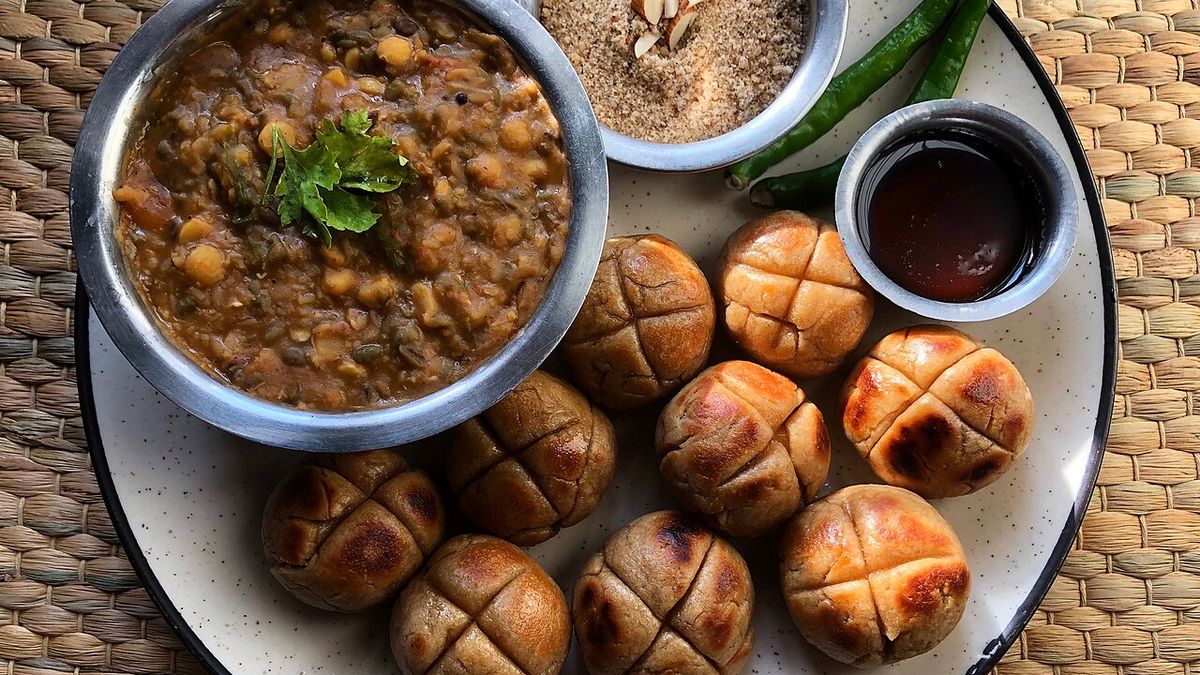
Dal baati churma is the Rajasthani meal of hard-crusted wheat dumplings baked and dunked in ghee, eaten with five-lentil dal and a sweet crumble of crushed baati and jaggery. Success rests on the moin: enough ghee rubbed into coarse atta that the flour holds when squeezed, so the baati bakes crumbly rather than rock hard.
- Prep
- 40 min
- Cook
- 1 hr 20 min
- Total time
- 2 hr
- Servings
- 6
- Vegetarian
- Festive
Ingredients
- 4 cups coarse whole wheat atta (about 480 g)
- 1/2 cup fine suji (semolina)
- 3/4 cup ghee, melted, for the baati dough
- 1 teaspoon ajwain (carom seeds)
- 1 1/2 teaspoons salt for the dough
- About 1 cup water, for binding the dough
- 1/2 cup ghee, warmed, for dipping the baati
- 1/2 cup toor dal
- 1/4 cup chana dal, soaked for 30 minutes
- 1/4 cup moong dal
- 2 tablespoons urad dal
- 2 tablespoons masoor dal
- 1/2 teaspoon turmeric powder
- 2 tablespoons ghee for the dal tadka
- 1 teaspoon cumin seeds
- A generous pinch of hing (asafoetida)
- 2 dried red chillies
- 1 inch ginger, finely chopped
- 2 green chillies, slit
- 2 medium tomatoes, finely chopped
- 2 teaspoons coriander powder
- 1 teaspoon red chilli powder
- 3 tablespoons ghee, for roasting the churma
- 1/2 cup powdered jaggery or bura (powdered sugar)
- 1/2 teaspoon green cardamom powder and 2 tablespoons chopped almonds
- Salt to taste for the dal, and 2 tablespoons chopped coriander leaves
NNWA health note
This is feast food, and it is honest to treat it that way. The dal is the sound part of the plate, with five pulses supplying plant protein and fibre, and the whole wheat adds more. The ghee is the part that adds up fast, because it goes into the dough, the tadka, the dip and the churma, and the churma is a sweet by any measure. Brushing the baati instead of dipping it, and taking more dal than baati, makes a real difference. Anyone managing diabetes or heart disease should agree portions with their doctor or dietitian.
Method
- 01
Mix the atta, suji, ajwain and salt in a wide bowl, pour in the 3/4 cup melted ghee and rub it through with your fingertips for 3 to 4 minutes. Squeeze a handful: it should hold its shape like damp sand and break when you press it with a thumb.
- 02
Add the water a little at a time and bring it together into a stiff, slightly rough dough, firmer than roti dough. Cover and rest for 15 minutes while the oven heats to 200 C.
- 03
Divide the dough into 16 equal balls, about the size of a small lime, and press each one lightly to dimple the top. Set them on a tray with a little space between them, with the 4 meant for churma together at one end of the tray.
- 04
Bake at 200 C for 20 minutes, turn every ball, then lower the heat to 180 C and bake for 20 to 25 minutes more. They are ready when deep golden with fine cracks on the surface, and a tap gives a hollow knock.
- 05
While the baati bakes, rinse all the dals, add the turmeric, salt and 5 cups of water, and pressure cook on medium for 4 whistles, then on low for 5 minutes. Let the pressure drop by itself and whisk the dal until it is creamy but still has some grain.
- 06
Heat 2 tablespoons of ghee on medium in a heavy pan, add the cumin until it crackles, about 20 seconds, then the hing, dried chillies, ginger and green chillies, and stir for 30 seconds until the ginger smells sharp and sweet.
- 07
Add the tomatoes, coriander powder and chilli powder and cook on medium for 6 to 8 minutes, until the tomato collapses and ghee shows at the edges. Pour in the dal, simmer on low for 10 minutes until it coats a ladle, and finish with the coriander leaves.
- 08
Break the 12 serving baati open with a clean cloth while still hot, because the steam inside burns. Warm the 1/2 cup ghee on low until just melted, then dip each baati for a few seconds, letting the crumb soak it up, and set aside in a covered dish.
- 09
For the churma, cool the 4 reserved baati for 10 minutes, break them up and pulse in a dry mixer to coarse crumbs. Roast the crumbs in 3 tablespoons of ghee on low for 5 to 7 minutes, stirring all the time, until they smell nutty and turn a shade darker.
- 10
Take the pan off the heat and wait 5 minutes until the crumbs are warm rather than hot, then stir in the powdered jaggery, cardamom and almonds so the jaggery coats without melting into lumps. Serve the baati with the hot dal ladled over and the churma on the side.
Last reviewed on 2 November 2026.
NNWA publishes the name and qualifications of everyone who writes and checks its material. You can see the full teaching team on the faculty page.
The origins of dal baati churma
This is the best known meal of Rajasthan, built for a dry region where wheat, pulses and ghee kept well and fresh vegetables did not. The common story has baati dough buried in hot sand and dug out hours later, which is hard to verify, though baking in embers or over dung-cake fires was certainly the old way and still is in villages. Today it is a meal for weddings, family gatherings and festivals. You crack the baati on your plate, let it drink some ghee, ladle dal over it and eat the churma alongside, so one mouthful is salty and the next is sweet.
This recipe gives the Rajasthani baked baati with panchmel dal, the mix of five pulses that the panchmel dal page covers on its own. In the Malwa region of Madhya Pradesh you will meet bafla, a close cousin that is boiled before it is baked and comes out softer.
The moin is the whole technique
Moin is the fat rubbed into flour before any water goes in. Each grain of flour gets coated, which stops gluten forming in long strands, and that is why a good baati snaps open and crumbles instead of chewing like a stale roll. Three quarters of a cup looks like too much the first time. Trust the handful test in step one. If the squeezed flour falls apart with no shape, add a spoon more ghee before any water.
Coarse atta matters almost as much. Fine chakki flour from a packet bakes denser, and the suji here is there to bring back some of the grit that older, coarser flour had. Keep the dough stiff, since a soft dough spreads and bakes into something closer to a bun.
Baking without a wood fire
An oven is the most reliable home method and gives the most even crust. Without one, use a gas baati cooker or a covered appe pan on the lowest flame for 30 to 35 minutes, turning every 7 minutes or so. The bafla route is the other fallback: boil the balls in salted water for 15 minutes until they float, drain, dry them, then roast in a heavy covered kadai until browned. That version is softer and takes less ghee, though it is a different texture from the original.
Common faults and how to rescue them
Hard as a stone usually means too little moin or too much water. A baati already baked this way can still be saved: crush it for churma, where the hardness stops mattering. Raw in the middle means the oven was too hot or the balls too big, so split them and return them to a 170 C oven for 10 minutes. If the crust colours too fast, drop the heat and move the tray lower. A dal that has gone thick while you wait only needs a splash of hot water and a brief simmer.
Churma that turns sticky had its jaggery added while the crumbs were too hot. Spread it on a plate to cool and rub it with your fingers to loosen it, then shape it into small laddoos if it refuses to break up. Nothing is lost.
Lighter versions and swaps
You can cut the dipping ghee to a brush on the cut face of each baati and keep most of the flavour. Do not cut the moin by more than a quarter, since that is where a baati turns hard. If you have only three dals, toor, chana and moong make a fine pot. Bura is the traditional sweetener in many homes and jaggery gives a deeper, caramel taste, and either works in the same quantity.
Serving it as a full spread
A full spread adds gatte ki sabzi, a sharp garlic chutney, sliced raw onion with lemon, and a glass of spiced buttermilk to cut through the ghee. If this kind of regional cooking interests you, the same wheat-and-embers logic runs through Bihar's litti chokha, which fills its dough with sattu. NNWA's culinary nutrition course looks at how to rework dishes like these without losing them.
Storing and reheating
Undipped baati keeps for 2 days in a tin at room temperature and about 4 days in the refrigerator. Reheat at 160 C for 8 minutes until the crust is crisp again, then dip. The dal keeps for 2 days chilled and thickens as it sits, so loosen it with water and bring it back to a full boil. Churma stays good in an airtight jar for about a week.
Learn the science
Culinary Nutrition (Nutrition Chef)
This dish's nutrition reasoning is taught in full in this NNWA course.
What people ask about Dal Baati Churma
Can I make baati without an oven?
Yes. A covered appe pan or a gas baati cooker on the lowest flame works, turned every few minutes until browned all round. Allow about half an hour, and test one by breaking it open before you take the batch off.
Why is baking soda not in this baati dough?
Many cooks add a pinch to lighten the crumb, and it is not wrong to do so. With enough ghee rubbed through coarse flour the baati crumbles well without it, and leaving it out avoids any soapy aftertaste.
What is the difference between baati and bafla?
Baati goes straight from dough to dry heat and has a harder, crackled crust. Bafla is boiled first, then baked or roasted, so it is softer inside and a little less demanding of the cook. Malwa is the home of bafla.
Can the baati be made ahead for guests?
Bake them in the morning and leave them undipped under a cloth. About fifteen minutes before the meal, crisp them in a medium oven, break them open and dip them in warm ghee. The dal can also be cooked ahead and given its tadka at the last minute.
Is onion or garlic used in the dal?
Homes differ. Plenty of Rajasthani households, including those who avoid onion and garlic for religious reasons, make it with only hing, ginger and tomato as written here. Others add garlic to the tadka, which works well if you enjoy a stronger dal.
More recipes
Bharli Vangi
Bharli vangi is the Maharashtrian dish of small brinjals stuffed with a roasted peanut, sesame and dry coconut masala, then simmered until s…
Vegetarian · VeganRecipeBhel Puri
Bhel puri is puffed rice tossed with sev, crushed puris, chopped onion, tomato and potato, and three chutneys: sweet tamarind, green coriand…
Vegetarian · VeganRecipe
Chicken Xacuti
Chicken xacuti is a Goan curry of chicken in a dark gravy built from coconut and a long list of whole spices, all roasted and ground. Pronou…
High-protein · Gluten-freeRecipe