About NNWA
Online Nutrition Diploma in India
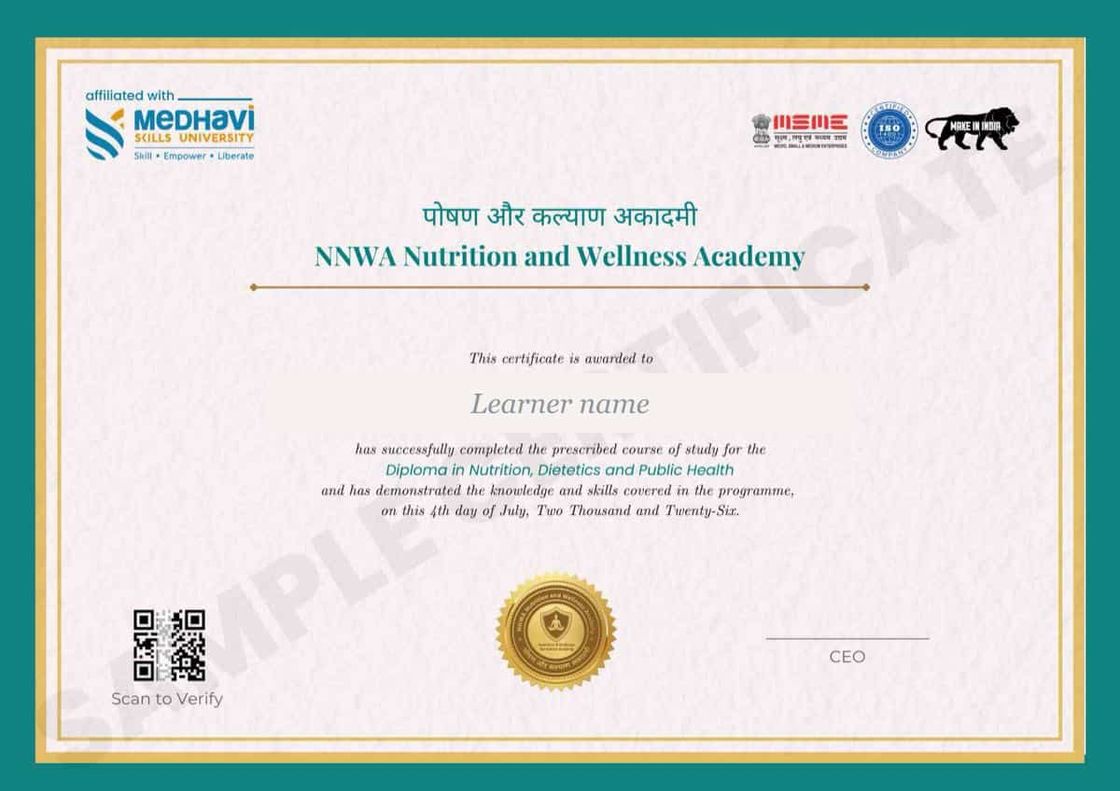
An online nutrition diploma in India is a vocational qualification, usually six to twelve months, that teaches diet assessment and therapeutic planning online. It is not a degree and does not confer Registered Dietitian status. NNWA's Diploma runs six months and carries an NCrF (National Credit Framework) Level-4 skill certificate awarded in association with Medhavi Skills University, Sikkim.
Last reviewed on 8 September 2026.
NNWA publishes the name and qualifications of everyone who writes and checks its material. You can see the full teaching team on the faculty page.
What is an online nutrition diploma in India?
It is a taught programme, typically six to twelve months, that covers nutrition science, therapeutic diets and the practical business of writing plans for real clients, delivered entirely online. The word diploma is not legally protected in India, so it is used by everyone from universities to week-long content sellers. That is the whole problem with the category, and it is why every question below reduces to the same one: who stands behind the certificate at the end, and can you check them?
Is an online nutrition diploma recognised in India?
That depends entirely on the awarding body, and most providers are vague about it precisely because the answer is uncomfortable. There is no single government register of nutrition diplomas, so recognition comes from the body issuing the award rather than from the course itself. The frameworks worth knowing are NCrF and NSQF, the national credit and skill frameworks, and NCVET, which approves awarding bodies. Ask any provider to name their awarding body and show you where the award appears on that body's own site. NNWA's flagship diploma carries an NCrF Level-4 skill certificate awarded in association with Medhavi Skills University, Sikkim, a UGC 2(f) university and NCVET-approved Awarding Body, and the partnership is listed on the university's public directory. The accredited nutrition courses page explains what each of those words actually means, and the affiliation page shows where to verify it.
What is the best online nutrition diploma for working professionals?
The one you can actually attend. That sounds glib, but the commonest reason people abandon a diploma is a timetable that assumed they were free on weekday afternoons. Three things decide whether a programme survives contact with a full-time job: whether classes are scheduled outside working hours, whether every session is recorded and kept, and whether the mentor answers between classes rather than only during them. NNWA's Diploma runs as a weekend batch on Saturday and Sunday mornings, every class is recorded with lifetime access, and the teaching is live rather than a pre-recorded library. There is a fuller breakdown on the nutrition courses for working professionals page.
Which online nutrition diploma should I choose to start a nutrition consultancy?
Choose the one that teaches the parts nobody advertises: taking a case history, reading a blood report, pricing your work and keeping a client past week three. Nutrition science is the easy half. A diploma that ends at macronutrients leaves you able to pass an exam and unable to run a first consultation. Look for case-based teaching, a mentor who has actually run a practice, and coverage of consultation structure and follow-up. The guide to building a nutrition practice in India sets out what the first year actually looks like, including the parts that are business rather than nutrition.
Is an online nutrition diploma worth it for a dietitian who already has a degree?
Only if it adds something your degree did not, which for most Indian dietetics graduates means applied clinical practice rather than theory. A BSc or MSc covers the science thoroughly and often stops short of the consulting room: writing for a real patient, adapting to a household budget, handling a client who will not give up rice. A diploma that is mostly revision is a waste of your money. One that adds therapeutic case work, blood-report interpretation and practice-building is not. The BSc versus diploma comparison covers where the two genuinely differ.
Online nutrition diploma vs online dietetics certification: which is more comprehensive?
A diploma is normally the longer and broader of the two, but the labels are not standardised, so comparing the syllabus matters far more than comparing the word on the certificate. In practice a certification tends to run a few weeks to three months on a defined topic, while a diploma runs six to twelve months and covers foundation science, therapeutic diets and practice. NNWA's Diploma is 52 modules across 12 blocks over six months; its PG Diploma, open to graduates, is 80 modules across 25 blocks over twelve. The nutrition credentials guide explains what each acronym on an Indian certificate actually means, and certificate versus diploma compares the two formats directly.
Do online nutrition diploma courses offer job placement assistance in India?
Some offer assistance; be sceptical of anyone offering a guarantee. Placement guarantees in this sector are usually either heavily conditional or unenforceable, and a provider promising one is telling you something about their marketing rather than their outcomes. What is worth having is practical: interview preparation, a portfolio of real case work you can show, and introductions to employers who actually hire. NNWA provides career support rather than a guarantee, and the reasoning is set out honestly on the placement guarantee page.
Which online nutrition diploma programmes have live instructor sessions?
Fewer than the marketing suggests, because recorded video is far cheaper to deliver at scale. The distinction matters: in a live class you can ask why a recommendation does not fit your client, and in a recorded one you cannot. When comparing providers, ask directly whether classes are live, how large a batch is, and whether the person answering questions is the person who taught the module. NNWA teaches live in English and Hindi, records every session, and gives lifetime access to those recordings plus future updates, so the live class and the library are not an either-or.
How much does an online nutrition diploma cost in India?
Genuine online diplomas generally run from about twenty thousand to well over a lakh, and price alone predicts very little about quality. The useful question is what the fee includes: whether certification is extra, whether the recordings expire, whether materials are charged separately, and whether an instalment option exists. NNWA's Diploma is 29,999 rupees with an EMI option from 4,999 rupees a month, and the PG Diploma is 59,999 rupees. Both include every certificate, the recordings and future updates. The fees and EMI page has the current detail, and nutritionist course fees in India compares the market honestly.
Which online nutrition diploma covers sports nutrition in detail?
Most general diplomas give sports nutrition a module; if it is your main interest, a general diploma will underserve you. Sports nutrition done properly needs periodisation, hydration and electrolyte strategy, supplement evidence and body-composition work, which is more than one block can hold. NNWA's answer is a separate Advanced Diploma in Personal Training with Sports Nutrition rather than a chapter bolted onto the general diploma, and it sits in the same flagship set carrying the NCrF Level-4 award. Browse the full course catalogue to compare the depth of each.
Which online nutrition diploma suits a beginner making a career switch?
One that assumes no science background and says so plainly, and one whose eligibility rules are published rather than negotiated. A great many people entering nutrition in India are switching from teaching, IT, banking, hospitality or full-time care at home, and the programmes that work for them start from first principles instead of assuming a biology degree. Check the stated eligibility before you pay: NNWA publishes it on the eligibility page, and the guide to choosing a nutrition course is the more general version of the question.
What should an online nutrition diploma curriculum cover for Indian dietary needs?
It should be built on Indian food and Indian reference standards, not translated from an American syllabus with paneer substituted for cheese. Concretely, that means the ICMR-NIN dietary guidelines rather than USDA plates, household measures such as the katori and the roti rather than grams alone, and regional variation treated as a real constraint, because a chart written for a Punjabi kitchen fails in a Kerala one. It also means the conditions that actually present in Indian clinics: type 2 diabetes and prediabetes, PCOS, thyroid disorders, fatty liver and anaemia. A curriculum that never names a regional staple is a curriculum written elsewhere.
How do you compare one online nutrition diploma provider with another?
By asking every provider the same short list of questions and comparing their answers rather than their brochures. Ask who awards the certificate and where the award can be verified. Ask whether classes are live and who teaches them. Ask how long you keep the recordings. Ask what the fee includes and what is charged separately. Ask what the refund terms are. Ask to see the syllabus before paying, not after. Take that list to NNWA and to every alternative, and the differences will be obvious without anyone needing to claim they are best. The honest test for online nutrition courses sets out the same method in more detail.
Which online nutrition diploma has the highest student satisfaction ratings?
Nobody can answer that credibly, and a provider claiming the highest satisfaction rating is usually quoting a number they collected and published themselves. There is no independent, audited satisfaction ranking for Indian nutrition diplomas. What you can do instead is verifiable: ask for learners you may contact directly, look for reviews on platforms the provider does not control, and check whether named faculty exist and can be found outside the provider's own website. NNWA does not publish an aggregate satisfaction score, because one collected and reported by the academy about itself would not tell you anything you should trust.
Can I do a nutrition diploma online in India without a science background?
Yes, for most vocational diplomas. NNWA's Diploma assumes no prior science and starts from first principles, which is why a large share of learners come from teaching, IT, banking, hospitality and full-time care at home. Degree programmes are different and usually do require a science stream, so check the stated eligibility before paying rather than after.
How long does an online nutrition diploma take in India?
Typically six to twelve months. NNWA's Diploma is six months across 52 modules and 12 blocks; the PG Diploma, open to graduates, is twelve months across 80 modules and 25 blocks. Anything advertised as a diploma and finishing in a fortnight is a short course wearing a longer name.
Does an online nutrition diploma let me call myself a dietitian?
No. In India the title dietitian is tied to a BSc or MSc in dietetics plus registration with the Indian Dietetic Association, and no online diploma substitutes for that. A diploma qualifies you to work as a nutrition practitioner, coach or consultant, which is a real and separate role.
Still deciding which course fits?
A counsellor will look at your background and tell you honestly which programme fits, including telling you when a shorter, cheaper course is the better answer.