
South Indian · Snack
Murukku
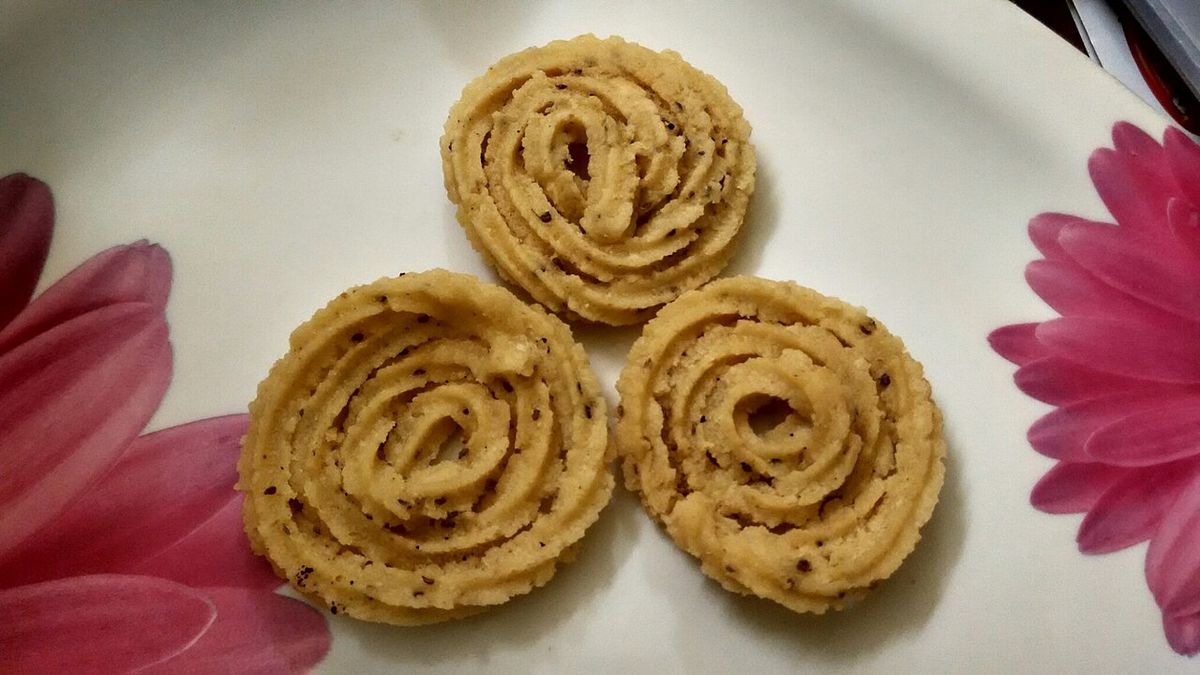
Murukku is a crisp, savoury spiral from Tamil Nadu made from rice flour and roasted urad flour, pressed into hot oil and fried until it stops bubbling. The dough decides whether it succeeds: too dry and it breaks in the press, too rich in butter and it falls apart or spits in the oil.
- Prep
- 25 min
- Cook
- 30 min
- Total time
- 55 min
- Servings
- 10
- Vegetarian
- Gluten-free
- Festive
Ingredients
- 2 cups fine rice flour, about 280 g
- 1/4 cup roasted urad dal flour, about 35 g
- 1 teaspoon salt, or to taste
- 1 teaspoon cumin seeds or white sesame seeds
- A pinch of asafoetida (hing)
- 2 tablespoons softened butter
- 2/3 to 3/4 cup warm water
- 3 cups oil, for deep frying, groundnut or another high-heat oil
NNWA health note
Murukku is a fried snack, and a very good one, so treat it as such. It is made from refined rice flour and takes up oil in the pan, which means it is easy to eat more than you meant to. Take two or three onto a plate with your tea and put the tin away. Frying at the right temperature limits how much oil is soaked up, and using fresh oil each time is better than reusing it many times. It is not a dish for daily snacking, and anyone with diabetes or high cholesterol should keep it for festivals and go by their dietitian's advice.
Method
- 01
Sift the rice flour and urad flour together into a wide bowl. Stir in the salt, cumin or sesame and asafoetida. Add the butter and rub it through with your fingertips for a minute or two until there are no lumps and a handful holds its shape when squeezed.
- 02
Add the warm water a little at a time and bring everything together into a soft, smooth, non-sticky dough. Do not knead hard. Pinch off a little: it should feel like soft clay with no cracks at the edges. Cover with a damp cloth.
- 03
Grease the inside of a murukku press and fit the star plate. Fill it with dough, and test by pressing out a thread. A smooth rope means the dough is right, while jagged or broken edges mean it needs a few drops more water.
- 04
Heat the oil in a deep, heavy kadhai to no more than halfway up its sides, over a medium flame, for about 5 minutes. Test with a pinch of dough: it should sink, then rise slowly with small bubbles in about 5 seconds. If it browns right away, the oil is too hot. A thermometer should read about 165 to 170 degrees Celsius.
- 05
Press 2 or 3 spirals onto the back of an oiled ladle or a square of greased baking paper, about 7 to 8 cm across, joining the end of the rope to the coil. Slide each one gently into the oil, keeping your hand low so nothing splashes. Fry only as many as float in one layer without touching.
- 06
Fry over a medium flame for 2 minutes without touching them, so that they set. Turn gently with a slotted spoon, then fry for 2 to 3 minutes more, turning once or twice, until golden. The loud fizzing dies down to almost nothing when they are done, which is the best cue of all.
- 07
Lift out and let the oil drip off for a few seconds, then lay them on a rack or kitchen paper. They crisp further as they cool. Bring the oil back up to temperature before the next batch, about 1 minute.
- 08
Cool completely, for at least 30 minutes, before moving them into a dry airtight tin. Any warmth trapped inside the tin softens the whole batch.
Last reviewed on 2 November 2026.
NNWA publishes the name and qualifications of everyone who writes and checks its material. You can see the full teaching team on the faculty page.
Where does murukku come from?
The word comes from the Tamil for twisted, and murukku is made in homes across Tamil Nadu above all for Diwali, along with other festive savouries. It is also tied to Manapparai in the Tiruchirappalli district, a town long known for its murukku. Kai murukku is the hand-twisted version, a skilled craft that takes years of practice. This recipe uses a press, which is how most homes do it. Maharashtra has a close relative in chakli, which is often made from a roasted multigrain flour called bhajani.
The technique: ratio, dough and oil
Rice flour gives crispness and urad flour gives lightness and a nutty flavour. Home ratios run from about four to eight parts rice to one part urad by volume, and this recipe uses eight, for a pale and very crisp murukku. Too much urad and the murukku browns quickly and tastes heavy. The butter gives a short, crumbly bite, and it must be measured. It is not a place to be generous, since excess fat weakens the dough and makes the spiral dissolve in the oil.
Roast the urad dal yourself if you can. Dry-roast it over a low flame until golden and fragrant, about 6 minutes, cool it and grind it fine, then sieve it. Fine rice flour is essential too, and if yours feels coarse, sieve it, or the murukku will be gritty. Oil temperature is the last step: medium heat, steady. Murukku fried too cool takes on oil, and when fried too hot it browns outside and stays raw and hard within.
What goes wrong, and how do you rescue it?
If the rope breaks as it leaves the press, the dough has dried out, so work a few teaspoons of warm water through it. Keep the rest of the dough covered as you work. If the spirals fall apart in the oil, there is too much butter or water in the dough. Add a spoonful of rice flour and try again with one spiral. If they turn out hard and dense, there was too little fat or too much kneading, and if they are oily, the oil was not hot enough.
Spitting oil is a real safety matter. It usually comes from wet dough, a wet spoon or sesame seeds that pop, so keep everything dry near the kadhai and use only a modest amount of sesame. If you are new to this, fry one spiral first and stand well back. Never leave hot oil unattended, keep children away from the stove, and if the oil ever smokes, turn the flame off right away. In case of a pan fire, cover it with a metal lid and never use water.
Substitutions, and is there a lighter version?
Ghee can replace butter one for one, and it tastes wonderful. Hot oil works as a vegan swap, with 2 tablespoons poured in and mixed well, though the bite is a little harder. Roasted gram flour (pottukadalai maavu) or besan can stand in for urad flour, and these are common family variations. Asafoetida usually contains wheat flour, so buy a labelled gluten-free packet if needed. Murukku can be baked or air-fried, but this is a different snack, drier and paler, so make your peace with that first. A more honest way of eating lighter is to fry smaller spirals and eat fewer. If you want something crunchy for every day, roasted makhana or masala peanuts are better habits.
What goes with murukku?
A cup of filter coffee or masala chai is all it needs. At Diwali it goes on the festive plate beside besan ladoo and Mysore pak. It is also a good thing to bring to a train journey or to give as a gift, since it travels well and keeps.
Storing
Kept completely dry in a clean airtight steel or glass tin, murukku stay crisp at room temperature for 2 to 3 weeks. Use a dry hand to take them out. If a batch softens, spread it on a baking tray and warm it at 140 degrees Celsius for about 8 minutes, or warm it for a few minutes in a dry kadhai over a low flame, then cool it fully before sealing. Cooled frying oil can be strained and used once more for the same kind of food, but discard oil that smells stale or has turned dark.
Learn the science
Healthy Eating & Everyday Wellness
This dish's nutrition reasoning is taught in full in this NNWA course.
What people ask about Murukku
Can I use shop-bought rice flour for murukku?
Yes. Most home cooks do, and it gives a very good result as long as it is fine and fresh. Sieve it first. Old flour can taste stale and absorbs water differently, so buy a new packet for a festive batch.
Which plate should I use in the press?
The classic is a single star or a three-hole plate that gives a ridged rope. Those ridges help the murukku cook evenly and turn crisp. A plain round plate gives a smooth, harder rope, which is closer in style to thenkuzhal, another Tamil favourite.
Why does my murukku taste bitter or burnt?
The oil has probably become too hot or carries fallen bits of dough that have burnt from an earlier batch. Skim the pan with a strainer between batches and lower the flame. Over-roasted urad flour can also bring a bitter edge to the batch.
How do I shape the spiral without a ladle?
Press the spirals onto a small sheet of greased baking paper or a square of banana leaf, then lift and slide each one into the oil with your fingers low. You can also press straight into the oil once you are confident, though this takes practice.
Can I make the dough in advance?
It is better not to, since rice flour dough dries and cracks within an hour or so. Mix a smaller quantity of flour with butter and salt, then add water just before pressing. You can prepare the dry mixture a day or two ahead.
More recipes
Adai (Mixed Lentil Crepe)
Adai is a thick South Indian crepe made from a coarsely ground batter of rice and several dals, typically chana, toor and urad, with dried c…
Vegetarian · VeganRecipeAppam
Appam is a Kerala pancake made from a fermented batter of raw rice, cooked rice and coconut, cooked in a curved pan so it forms thin lacy ed…
Vegetarian · Gluten-freeRecipeAvial (Kerala Mixed Vegetable Curry in Coconut-Yoghurt Sauce)
Avial is a Kerala main course of mixed vegetables simmered in a coconut and green chilli paste and finished with a spoonful of yoghurt and r…
Vegetarian · Gut-healthRecipe