
South Indian · Dessert
Mysore Pak
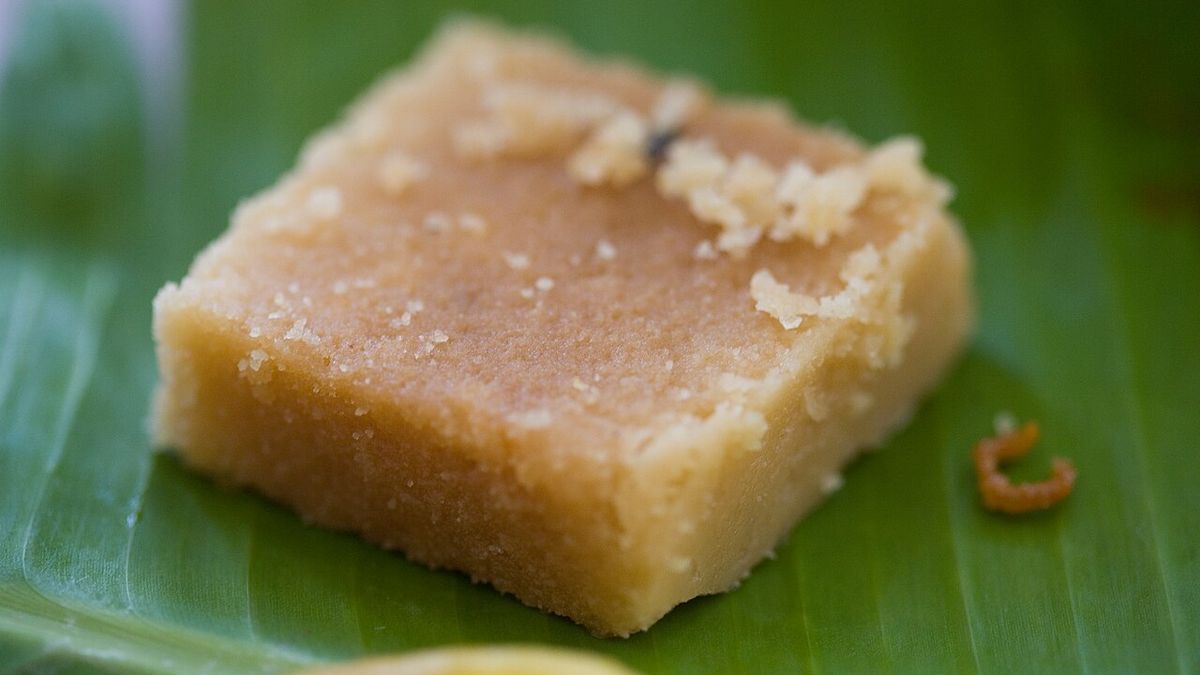
Mysore pak is a rich Karnataka sweet made from besan, sugar syrup and a large amount of hot ghee, cooked until it froths and sets with a fine honeycomb inside. Timing decides whether it succeeds: pour it out as soon as it pulls away from the pan, because a minute too long makes it hard.
- Prep
- 10 min
- Cook
- 25 min
- Total time
- 35 min
- Servings
- 16
- Vegetarian
- Gluten-free
- Festive
Ingredients
- 1 cup besan (gram flour), about 120 g
- 1 1/2 cups sugar, about 300 g
- 1/2 cup water, about 120 ml
- 1 1/2 cups ghee, about 300 g
- 1 teaspoon ghee, for greasing the tin
- 1/4 teaspoon cardamom powder (optional)
NNWA health note
Mysore pak is a sweet, and an unashamedly rich one, with sugar and ghee making up most of each piece. Besan adds a little protein but does not change what this is. Enjoy one small piece slowly at a festival or after a meal, and share the rest. People with diabetes, or anyone watching their weight or cholesterol, should count it as an occasional treat within the plan their doctor or dietitian has given them. Cutting the ghee sharply will not make it a light sweet, only a harder one, so a smaller portion is the more honest route.
Method
- 01
Grease a square steel tin or thali, about 20 cm across, and keep it next to the stove with a spatula. Everything moves quickly at the end, so have it ready now.
- 02
Sieve the besan twice. Melt the ghee in a small pan, then stir 1/4 cup of it into the besan until you have a smooth, pourable paste with no lumps. Keep the rest of the ghee hot on the lowest flame.
- 03
Put the sugar and water in a heavy, wide-based kadhai over a medium flame and stir until the sugar has dissolved. Boil for 6 to 7 minutes, without stirring, until the syrup reaches one-string stage: let a drop cool for a few seconds, then pull it between thumb and finger, and it should form one thread. Hot syrup burns badly, so use a spoon and take care.
- 04
Lower the flame to medium-low and pour the besan paste into the syrup in a thin stream, stirring all the time. It will thicken and turn glossy within 1 to 2 minutes, and there should be no lumps.
- 05
Add 2 tablespoons of the hot ghee. It will sizzle and foam. Stir until it has been absorbed and the mixture looks dry again, about 1 minute, then add 2 more tablespoons.
- 06
Keep adding the ghee this way over 10 to 12 minutes, stirring without a pause and scraping the bottom of the pan. The colour moves from bright yellow to a deeper gold and the smell turns from raw flour to roasted nuts.
- 07
Watch for the moment of readiness: the mass froths up, lightens, pulls cleanly from the sides and starts to leave a little ghee around the edge. Stir in the cardamom if you are using it and stop adding ghee, even if some is left over.
- 08
Pour immediately into the greased tin and level it with one or two quick strokes. Do not press it flat, since that closes the small holes inside.
- 09
Leave for 5 minutes, then score it into 16 pieces with a greased knife while it is still warm. Let it cool completely, about 1 hour, before lifting the pieces out.
Last reviewed on 2 November 2026.
NNWA publishes the name and qualifications of everyone who writes and checks its material. You can see the full teaching team on the faculty page.
Where does Mysore pak come from?
The sweet is widely said to have been created in the palace kitchens of Mysuru in the time of the Wodeyar kings, and it remains a fixture of Karnataka weddings, festivals and gift boxes. It is also made across Tamil Nadu and Andhra Pradesh, where sweet shops sell the softer styles. The name is simple enough: pak or paka refers to the sugar syrup. In Karnataka a piece often appears on the banana leaf at a feast meal.
Crumbly or melt-in-the-mouth
Two styles go by the name. The older one is firmer, darker and porous, with less ghee and a texture that crumbles when bitten. The newer soft version uses far more ghee and stays almost fudgy. This recipe sits close to the soft style but is cooked long enough to form the fine holes of the traditional sweet. To go more traditional, reduce the ghee to 1 cup and cook a minute or two longer.
The technique that decides the texture
Two things matter most: the syrup and the temperature of the ghee. A one-string syrup carries enough sugar for the sweet to set yet is still fluid enough for the besan to hydrate. Hot ghee is the second. When it hits the mixture, it fries the flour and the water left in the syrup boils off, and those tiny steam bubbles leave the honeycomb. Cold ghee cannot do this and the mixture turns greasy instead of frothy, so keep it warming on the next burner.
A heavy pan helps a great deal, since a thin kadhai scorches the besan on the bottom long before the rest is ready. Keep the spatula moving and stay by the stove for the full stretch, since this is not a sweet that lets you answer the door.
What goes wrong, and how do you rescue it?
If the mixture never sets, it was taken off too early. Scrape it back into the pan and stir over a medium-low flame for 2 to 4 minutes more until it froths and pulls away. If it sets hard as a brick, it stayed on too long or the syrup went past one-string. It will not soften again, but broken up, it makes a pleasant crumble over rice kheer or a topping for ice cream. If it tastes of raw flour, the besan was not cooked enough, and the next batch needs more time and a lower flame. Dark brown bits mean it has scorched, usually from a pause in the stirring. Lumps come from adding the paste too quickly or skipping the sieve, so do not rush that stage.
If you cannot get a reading on the syrup by hand, a sugar thermometer should read about 105 to 107 degrees Celsius for a thread.
Can it be made lighter?
Not honestly. You can reduce the sugar to 1 1/4 cups without harm, though the set becomes softer, and using 1 cup of ghee gives the firmer crumbly style. Oil does not work as a swap for ghee, because the aroma and the way it sets are the whole sweet. Replacing sugar with jaggery is sometimes tried, but jaggery behaves differently in syrup and darkens fast, so the texture will not match. It is better to cut smaller pieces. Anyone with diabetes will find practical advice in the guide to the festive season with diabetes. Sourced figures for similar gram-flour sweets are on the besan barfi page.
What goes with it, and how long does it keep?
Serve small pieces at room temperature with a strong filter coffee, or on a festive sweets plate alongside besan ladoo and kaju katli. It stores well because it holds so little moisture: keep it in an airtight tin at room temperature for about a week, or two weeks in the fridge. Refrigerated pieces harden, so bring them back to room temperature for 30 minutes before eating. Use a dry spoon or clean fingers to lift pieces out, since damp hands shorten its life.
Learn the science
Healthy Eating & Everyday Wellness
This dish's nutrition reasoning is taught in full in this NNWA course.
What people ask about Mysore Pak
Does Mysore pak need all that ghee?
The soft version does, since ghee provides both the flavour and the structure. The traditional firmer style uses about two-thirds as much and is still delicious. Below that, the sweet turns dry and floury rather than light, so the saving is not worth the loss.
Why did my Mysore pak turn out chewy?
A chewy result generally means the syrup did not reach one-string, or the mixture left the flame before the water had cooked off. Next time, test the syrup with care and wait for the froth and the clean pull from the sides.
Is Mysore pak gluten-free?
The three main ingredients contain no wheat, so a batch made at home fits a gluten-free diet. Shop-bought besan can pick up traces of wheat at the mill, however, so anyone with coeliac disease should buy a certified packet.
Can I double the recipe?
It is possible but harder to manage, because a larger batch needs a longer stir and cooks unevenly in a home kadhai. Making two separate batches is more reliable, and the second tends to go faster once your eye has learned the signs.
Why is my Mysore pak oily on the surface?
A thin film usually means slightly more ghee went in than the besan could hold. Tilt the tin as the sweet cools and drain the extra off, or blot gently with kitchen paper. The texture is usually unharmed and the pieces still set well.
More recipes
Adai (Mixed Lentil Crepe)
Adai is a thick South Indian crepe made from a coarsely ground batter of rice and several dals, typically chana, toor and urad, with dried c…
Vegetarian · VeganRecipeAppam
Appam is a Kerala pancake made from a fermented batter of raw rice, cooked rice and coconut, cooked in a curved pan so it forms thin lacy ed…
Vegetarian · Gluten-freeRecipeAvial (Kerala Mixed Vegetable Curry in Coconut-Yoghurt Sauce)
Avial is a Kerala main course of mixed vegetables simmered in a coconut and green chilli paste and finished with a spoonful of yoghurt and r…
Vegetarian · Gut-healthRecipe