
West Indian · Main course
Laal Maas
Laal maas is a fiery Rajasthani mutton curry, red from dried Mathania chillies and rich with ghee, garlic and yoghurt. What decides it is the chilli paste: soaked well, fried slowly until the raw edge goes and the ghee turns red, then given a long, low simmer so the mutton softens and the heat rounds out.
- Prep
- 25 min
- Cook
- 1 hr 45 min
- Total time
- 2 hr 10 min
- Servings
- 5
- High-protein
- Gluten-free
Ingredients
- 750 g mutton, bone-in curry cut, from the shoulder or leg
- 20 dried Mathania red chillies, or 14 Kashmiri plus 4 Byadgi or Guntur
- 1 cup thick yoghurt, at room temperature, whisked smooth
- 1/2 cup ghee
- 3 large onions (about 400 g), thinly sliced
- 2 tablespoons garlic paste
- 1 tablespoon ginger paste
- 1 tablespoon coriander powder
- 1/2 teaspoon turmeric powder
- 4 green cardamom
- 2 black cardamom
- 4 cloves
- 1 inch cinnamon
- 2 bay leaves
- Salt to taste
- 2 1/2 cups hot water, added in stages
- 2 tablespoons chopped coriander leaves, to finish
NNWA health note
Mutton brings a good amount of protein and well-absorbed iron, and the yoghurt adds a little calcium. The honest caveat is the ghee together with the fat of the meat itself, which puts this firmly in the rich and occasional group. Skimming some of the red ghee off the top before serving removes more fat than you might expect, and it loses little flavour. A generous spoon of plain vegetables or salad alongside brings fibre that the curry does not have. If very hot food gives you reflux, seed the chillies well or use mostly Kashmiri.
Method
- 01
Break the chillies open and shake out as many seeds as you wish to lose, since the seeds carry much of the heat. Soak in 1 cup of very hot water for 30 minutes until soft, then blend with a little of the soaking water to a smooth red paste.
- 02
Heat the ghee on medium in a heavy-bottomed pot and add the whole spices and bay leaves. When the cardamom swells and the kitchen smells of cloves, about 30 seconds, add the onions.
- 03
Fry the onions on medium for 15 to 18 minutes, stirring often and more often at the end, until evenly deep golden brown with no pale patches. Do not let them go black, because burnt onion will turn the whole pot bitter.
- 04
Add the mutton and turn the heat to medium-high. Sear for 10 to 12 minutes, stirring, until the pieces lose all pinkness and the liquid they release has dried off and you can hear them sizzle in the ghee again.
- 05
Stir in the garlic paste, ginger paste and salt and cook on medium for 3 minutes, until the raw garlic smell is gone and the pot smells sweet.
- 06
Add the chilli paste, turmeric and coriander powder and fry on medium for 8 to 10 minutes, stirring and scraping, until the paste darkens to brick red and the ghee floats up red around the edges. Add a splash of water if it starts to catch.
- 07
Take the pot off the heat for 1 minute, then add the yoghurt a spoonful at a time, stirring without stopping. Return it to low heat and cook for 8 to 10 minutes, until the yoghurt is absorbed and the ghee separates once more.
- 08
Pour in 1 1/2 cups of hot water, bring to a gentle bubble and cover. Simmer on the lowest flame for 60 to 75 minutes, stirring every 15 minutes and adding the rest of the water as the gravy thickens, until the meat slides easily from the bone.
- 09
Uncover, simmer on low for 5 to 8 minutes more until the gravy is thick and coats a spoon with a layer of red ghee on top. Rest it covered for 10 minutes, then scatter over the coriander and serve.
Last reviewed on 2 November 2026.
NNWA publishes the name and qualifications of everyone who writes and checks its material. You can see the full teaching team on the faculty page.
The origins of laal maas
Laal maas means red meat, and the name is about the colour of the gravy rather than the animal. It belongs to the Rajput kitchens of Rajasthan, and it is widely said to have started with game brought back from the hunt, with the chilli and garlic there to deal with its strong taste. Today it is made with mutton in homes and at celebrations, and a good one is a matter of local pride. It is eaten hot with bajra roti or plain rice, and it is meant to make you reach for the water glass.
Home recipes differ on small points. Some use whole garlic cloves, some add a spoon of mustard oil with the ghee, some leave out the onion altogether. The version here uses browned onions, yoghurt and ghee, and it is close to what you will find in many Rajasthani homes.
The chilli does the real work
Mathania chillies, named for a village near Jodhpur, are the traditional choice for their deep colour and strong but fruity heat. They can be hard to find away from Rajasthan. The Kashmiri and Byadgi blend in the ingredient list gets close, with Kashmiri for most of the colour and the small hot chillies to bring back the bite. Using only Kashmiri is fine if you want a milder, still very red curry.
Frying the paste is the step people rush. Raw chilli paste tastes harsh and grassy. Held on medium heat in ghee, it loses that edge, turns from bright red to brick red and starts to smell almost like roasted peppers. That is the sign to stop, and it usually takes the full ten minutes. Hurry on to the yoghurt and you will taste it in the finished pot.
Slow heat and the mutton
Shoulder and leg are full of connective tissue, and it softens only with slow, wet heat. Bone-in pieces give the gravy body as well. A pressure cooker cuts the simmer to around 4 whistles on low, then a natural release, and this is a fair shortcut on a weeknight. You lose some depth, so simmer it open for 10 minutes afterwards to bring the gravy back together. The same slow treatment runs through the gentler, fennel-scented rogan josh and a home-style mutton curry, both good next steps if this one is too hot for your household.
Common faults and how to rescue them
Grainy, split gravy means the yoghurt went in over a high flame or straight from the refrigerator. It still tastes fine. Keep the heat low and simmer on, and the long cooking will smooth out most of it. Bitterness usually comes from onions or chilli paste that caught on the bottom. Move the curry to a clean pot without scraping the burnt layer, and add a spoon of whisked yoghurt.
If it is too hot to eat, the answer is more fat and dairy, not sugar. Stir in 2 or 3 tablespoons of whisked yoghurt off the heat, warm through gently, and serve with extra rice and a bowl of plain curd. Tough meat simply needs more time. Add hot water and keep going, because older mutton can take up to two hours.
The smoked finish, if you want it
Some cooks finish with dhungar: a live piece of charcoal set in a small steel bowl on top of the curry, a few drops of ghee poured over it, and the lid closed for 3 minutes. It gives a campfire smell that suits the dish. Do this with the window open and the exhaust running, because burning charcoal gives off carbon monoxide, and lift the bowl out with tongs. It is optional, and the curry does not need it to be good.
Serving, storing and reheating
Bajra roti is the traditional partner, and phulka or steamed rice work well. Plain jeera rice is a good bridge if your guests are not used to this much heat, and sliced raw onion with lemon cuts through the ghee. Anyone planning meals around protein will find that a modest portion goes a long way, a point NNWA's sports nutrition course covers in more depth.
Laal maas improves overnight, as the heat settles and the spices round out. Cool it within 2 hours and keep it covered in the refrigerator for up to 3 days, or freeze it for a month. Reheat gently with a splash of water, bringing it to a steady simmer all the way through before you serve it.
Learn the science
Sports Nutrition
This dish's nutrition reasoning is taught in full in this NNWA course.
What people ask about Laal Maas
How do I make laal maas less spicy without losing the colour?
Seed the chillies thoroughly and use all Kashmiri, which gives a deep red with mild heat. A few extra spoons of yoghurt also soften it. The dish will be gentler than the original, but it will look right and still taste rich.
Can I make it with chicken?
You can, and the result is often called laal murgh. Use bone-in pieces, cut the covered simmer to about 25 minutes and keep the rest of the method the same. It will have less depth than mutton, since the long cooking gives mutton much of its flavour.
Should laal maas have tomatoes?
The traditional version does not, and the tang comes entirely from yoghurt. Adding tomato changes both the flavour and the colour, turning it closer to an everyday mutton curry. If yours is not tart enough, a little more yoghurt or a squeeze of lemon is the better fix.
How much ghee does it really need?
Half a cup across five servings gives the proper red layer on top, but a third of a cup still works if you fry the onions and paste patiently. Going much lower makes the chilli paste likely to burn before it has cooked through.
More recipes
Bharli Vangi
Bharli vangi is the Maharashtrian dish of small brinjals stuffed with a roasted peanut, sesame and dry coconut masala, then simmered until s…
Vegetarian · VeganRecipeBhel Puri
Bhel puri is puffed rice tossed with sev, crushed puris, chopped onion, tomato and potato, and three chutneys: sweet tamarind, green coriand…
Vegetarian · VeganRecipe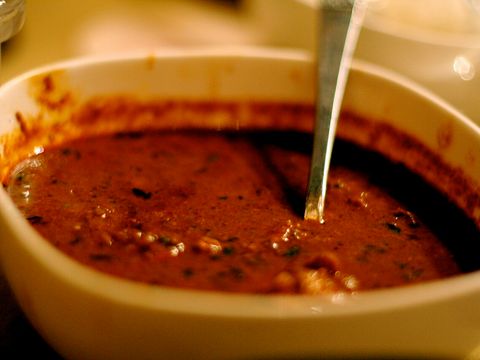
Chicken Xacuti
Chicken xacuti is a Goan curry of chicken in a dark gravy built from coconut and a long list of whole spices, all roasted and ground. Pronou…
High-protein · Gluten-freeRecipe