
South Indian · Side dish
Mirchi Ka Salan
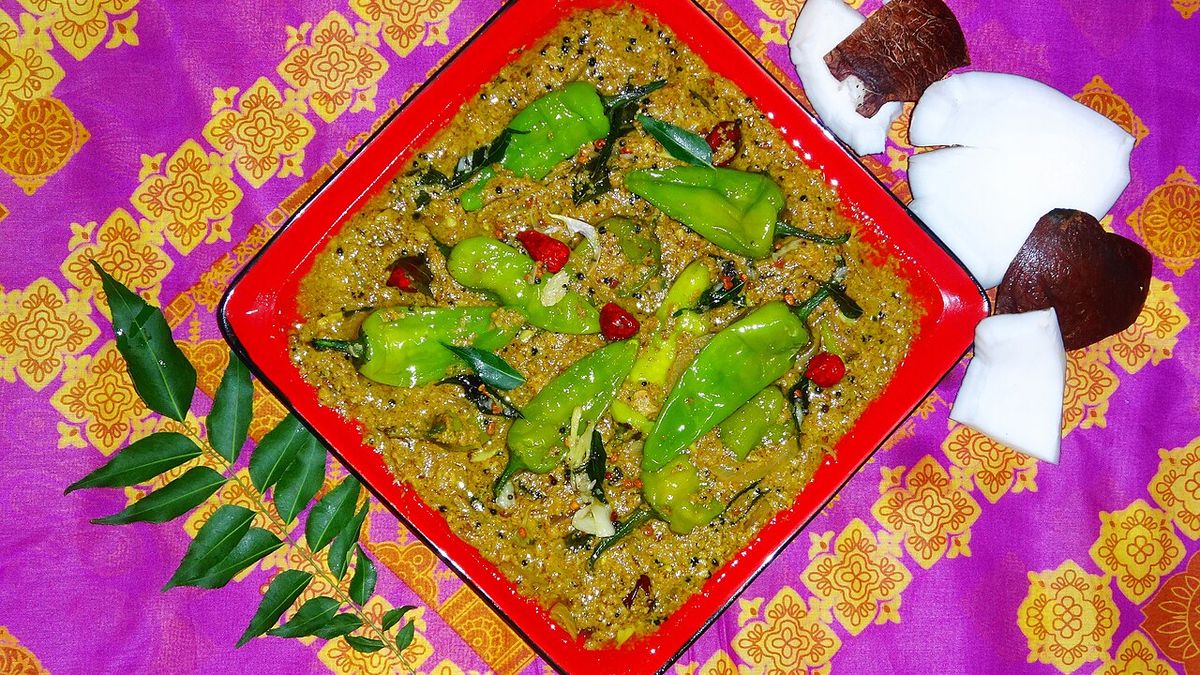
Mirchi ka salan is a Hyderabadi gravy of long, mild green chillies fried and simmered in a tangy paste of roasted peanuts, sesame and dry coconut, traditionally served with biryani. Slow frying of the paste decides it: cooked until oil rises, it turns rich and nutty, and hurried, it tastes raw, floury and heavy.
- Prep
- 20 min
- Cook
- 45 min
- Total time
- 1 hr 5 min
- Servings
- 6
- Vegetarian
- Vegan
- Gluten-free
Ingredients
- 250 g long, thick, mild green chillies (bhavnagri), about 10 to 12
- 1/4 cup raw peanuts, about 40 g
- 2 tablespoons white sesame seeds (til)
- 2 tablespoons grated dry coconut (kopra)
- 1 teaspoon coriander seeds
- 6 tablespoons neutral oil
- 1/2 teaspoon mustard seeds
- 1/2 teaspoon cumin seeds
- 1/4 teaspoon nigella seeds (kalonji)
- 12 curry leaves
- 2 medium onions, about 200 g, finely chopped
- 1 tablespoon ginger-garlic paste
- 1/2 teaspoon turmeric
- 1 teaspoon red chilli powder
- 1 teaspoon salt, or to taste
- 2 tablespoons thick tamarind pulp, from a lime-sized ball soaked in 1/4 cup hot water
- 1 teaspoon grated jaggery
- 1 1/2 cups warm water
NNWA health note
Mirchi ka salan is a condiment-like side, meant to be eaten in small amounts beside biryani, not as the main event. Peanuts and sesame give some protein, unsaturated fat and fibre, while the oil makes it a rich gravy overall. Because it is so flavourful, a tablespoon or two goes a long way. People with a peanut or sesame allergy should avoid it entirely. The slick of oil on top is part of the dish, but you are welcome to spoon some off before serving, and you lose little.
Method
- 01
Wash the chillies and dry them completely with a towel, because any water will make them spit in the oil. Slit each one lengthwise, keeping the stem and tip attached, and scrape out the seeds with a small spoon. Wear gloves, or wash your hands carefully and avoid your eyes.
- 02
Dry roast the peanuts in a pan on medium-low heat for 4 to 5 minutes, until golden and starting to smell nutty, and tip them out. Roast the sesame for 1 to 2 minutes until they start to pop, and the coconut and coriander seeds together for about 1 minute until light brown.
- 03
Cool everything for 5 minutes, then grind in a mixer jar with about 1/3 cup of water to a smooth, thick paste. Stop to scrape the jar, and grind until no grit remains between your fingers.
- 04
Heat the oil in a heavy pan on medium heat and fry the chillies in two batches for 3 to 4 minutes per batch, using a splatter guard or lid, until blistered and khaki-green in patches. Lift them out onto a plate.
- 05
In the same oil, on medium heat, add the mustard, cumin, nigella and curry leaves and let them crackle for about 20 seconds. Add the onions and fry for 8 to 10 minutes, until golden brown and soft, then add the ginger-garlic paste and stir for 2 minutes until the raw smell has gone.
- 06
Reduce the heat to low. Stir in the turmeric and chilli powder for 20 seconds, then add the ground paste and fry for 10 to 12 minutes, stirring often and scraping the base, until the colour deepens to reddish brown and oil begins to appear around the edges.
- 07
Pour in the warm water, tamarind pulp, jaggery and salt, stirring until smooth. Bring it to a gentle simmer on medium-low heat and cook uncovered for 5 minutes, until the gravy looks glossy and coats a spoon.
- 08
Slide in the fried chillies, cover, and simmer on low heat for 8 to 10 minutes, stirring gently once or twice so they do not break, until they are tender and a layer of oil floats on top. Turn off the heat and rest for at least 30 minutes before serving.
Last reviewed on 2 November 2026.
NNWA publishes the name and qualifications of everyone who writes and checks its material. You can see the full teaching team on the faculty page.
Hyderabad's partner for biryani
Mirchi ka salan comes from the Hyderabadi kitchen, and it is the customary accompaniment to Hyderabadi biryani alongside raita, usually at weddings and at any serious biryani house in the city. Its ground paste of peanuts, sesame and dry coconut sharpened with tamarind belongs to the Deccan, and the same family of gravies gives you bagara baingan, which uses small brinjals. The dish is a good example of that region's love of nutty, sour and hot flavours at once.
Though the name means chilli curry, it is not a test of bravery. The traditional chillies are long, pale and quite mild, and the gravy is tangy and rich in place of being simply hot.
Choosing and taming the chillies
The right chilli is the difference between a pleasant side dish and a painful one. Look for bhavnagri or other long, thick-walled, light green chillies, sometimes sold as pakoda or bajji mirchi. Small, thin, dark green chillies are far too hot for this purpose. Removing the seeds and white membrane takes out much of the remaining heat. If your chillies turn out hotter than expected, a few minutes of soaking in salted water with a spoon of lemon before frying can soften them somewhat; dry them thoroughly afterwards.
Outside India, banana peppers or Anaheim chillies are fair substitutes. As a shortcut for children or the heat-averse, cook long strips of green capsicum instead. It will not be traditional, but the gravy is still delicious.
Frying the paste until the oil rises
This is the stage people rush. Nut and seed pastes are thick and contain natural oils, so they catch easily on the base of a thin pan, and they taste heavy and raw if undercooked. Keep the flame low, use a heavy pan and stir regularly, scraping well. After about ten minutes the paste darkens, smells roasted and starts to release fat. Only then should you add the water.
Peanuts should be roasted just until golden, as dark ones make the gravy bitter. Taste a roasted peanut before grinding if you are unsure. Sesame also turns bitter if it is taken too far, so remove it as soon as it starts to pop. Grinding everything to a truly smooth paste gives a silky gravy; a coarse paste feels gritty and tends to separate.
Common mistakes and the rescue
If the salan tastes flat, it probably needs more tamarind and salt. Add a teaspoon of tamarind at a time and simmer for a couple of minutes between each. A bitter gravy usually means a dark roast; a teaspoon more of jaggery and a little more tamarind help to balance it, though it will not disappear entirely. If it is too thick, as it often gets on standing, stir in hot water until it pours like a thin custard, then correct the salt.
Chillies that fall apart were fried too long or stirred too hard; next time, take them off at the first patches of blister and shake the pan in place of stirring. Oil that fails to separate at the end usually means the paste was not cooked for long enough. Simmer uncovered on low heat for a further ten minutes, and it will come.
Substitutions and a lighter version
If peanuts are a problem, roasted cashews or melon seeds can make a similar base; for a sesame allergy, use a little more peanut. Fresh coconut is less traditional than dry kopra and spoils sooner, though it will do at a pinch. Some households add a spoonful of whisked curd at the end, in which case the recipe is no longer vegan. Ordinary sugar can replace the jaggery.
For a lighter pot, shallow-fry the chillies in two tablespoons of oil and use another two for the masala, then keep your portions small. The dish loses some of its gloss but very little of its taste. Roasting the peanuts dry instead of in oil already saves some fat.
Serving, storing and reheating
Serve it warm with chicken biryani or veg biryani, plus a cooling boondi raita. It also goes surprisingly well with plain rice and dal, or roti on a day when you want something sharp, and leftover salan is good beside a simple vegetable pulao.
The flavour is better after a few hours and at its best the following day, which makes it useful for entertaining. Refrigerate in a sealed box within two hours, and eat within four days. It freezes well for a month, although the chillies soften. Warm it gently on low heat with a splash of water, stirring until hot, and check the salt, since the gravy thickens as it stands.
Learn the science
Culinary Nutrition (Nutrition Chef)
This dish's nutrition reasoning is taught in full in this NNWA course.
What people ask about Mirchi Ka Salan
Is mirchi ka salan very hot?
Made with the right chillies and with their seeds removed, it is pleasantly warm, with more tang and nuttiness than burn. The heat comes mainly from the chilli powder and any seeds that remain, so reduce those first if you are cooking for children or for sensitive eaters.
Can I make mirchi ka salan without coconut?
Yes. Increase the peanuts by about a tablespoon and the sesame slightly, and the gravy will be a little less sweet and rounded but still good. Some Hyderabadi cooks use a small amount of poppy seed in addition, which adds body without changing the flavour very much.
How is it different from bagara baingan?
The gravy is very close, with the same roasted peanut, sesame and coconut base and tamarind sourness. Bagara baingan uses small whole brinjals and is often served as a side dish in its own right, while mirchi ka salan uses long green chillies and goes with biryani.
Why does the gravy thicken so much after standing?
Ground peanuts and sesame continue to absorb water for hours, so a gravy that looked right on the stove can turn stiff when cold. Keep it slightly thinner than you want it, and always loosen with a little hot water when reheating, adjusting the salt and tamarind to finish.
Can I make the paste ahead of time?
Yes. The ground paste keeps for about three days in the fridge in a sealed jar, or a month in the freezer. Dry-roasted but unground ingredients keep for a couple of weeks in a sealed jar. Fresh grinding gives the best flavour, but stored paste is a practical shortcut.
More recipes
Adai (Mixed Lentil Crepe)
Adai is a thick South Indian crepe made from a coarsely ground batter of rice and several dals, typically chana, toor and urad, with dried c…
Vegetarian · VeganRecipeAppam
Appam is a Kerala pancake made from a fermented batter of raw rice, cooked rice and coconut, cooked in a curved pan so it forms thin lacy ed…
Vegetarian · Gluten-freeRecipeAvial (Kerala Mixed Vegetable Curry in Coconut-Yoghurt Sauce)
Avial is a Kerala main course of mixed vegetables simmered in a coconut and green chilli paste and finished with a spoonful of yoghurt and r…
Vegetarian · Gut-healthRecipe