
North Indian · Side dish
Boondi Raita
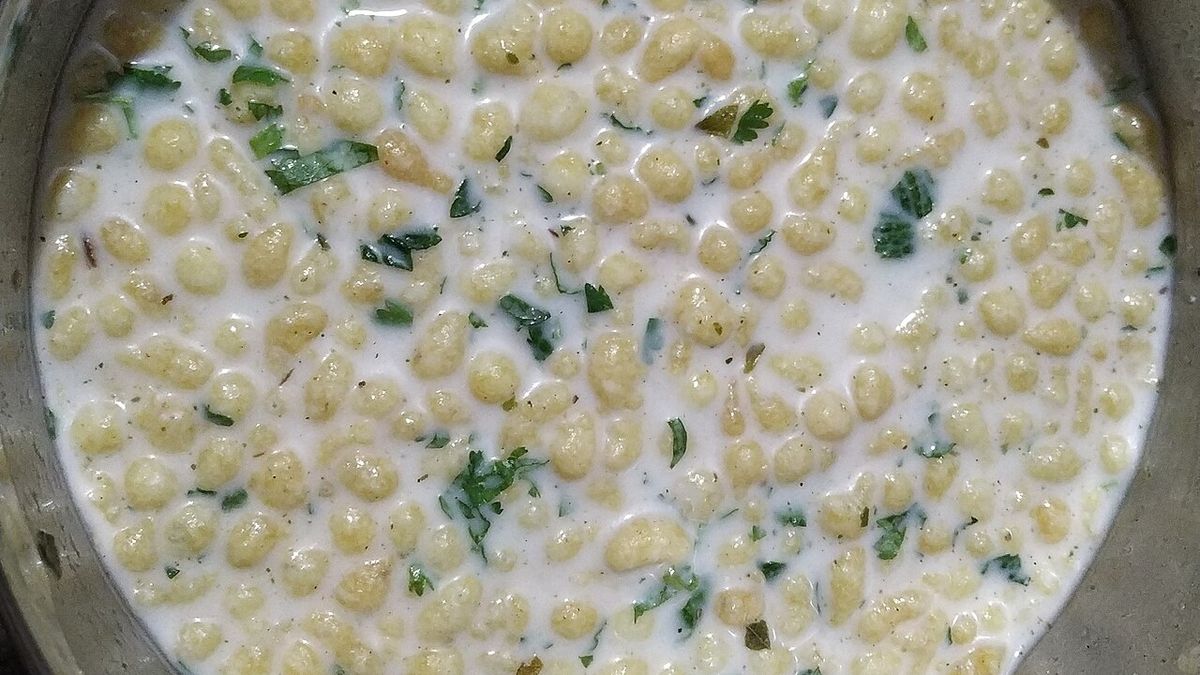
Boondi raita is a North Indian side of whisked curd with small fried gram flour pearls, roasted cumin, black salt and chilli, served cool with rich meals. Timing decides it: soak the boondi briefly in warm water, squeeze it gently and fold it in shortly before serving, so that it is soft and never soggy.
- Prep
- 10 min
- Cook
- 2 min
- Total time
- 12 min
- Servings
- 4
- Vegetarian
Ingredients
- 2 cups thick fresh curd (dahi), about 500 g, chilled
- 3/4 cup salted boondi (khari boondi), about 50 g
- 2 cups warm water, for soaking
- 1/4 cup cold water or milk, to adjust the consistency
- 1 teaspoon cumin seeds
- 1/2 teaspoon black salt (kala namak)
- 1/4 teaspoon salt, or to taste
- 1/4 teaspoon Kashmiri red chilli powder
- 1 teaspoon sugar, optional
- 1 tablespoon finely chopped coriander or mint leaves
NNWA health note
Curd is the real substance of this side, bringing protein, calcium and, if unheated and fresh, live cultures. The boondi is deep-fried, and although soaking removes a little surface oil, it is still a fried garnish. A good bowl beside biryani or a rich gravy adds protein and coolness to a heavy meal. Commercial boondi and black salt both bring sodium, so anyone advised to limit salt should use less of each. Replacing boondi with cucumber makes it a better everyday raita.
Method
- 01
Toast the cumin seeds in a small dry pan on medium-low heat for about 2 minutes, shaking often, until they darken a shade and smell warm and nutty. Cool them on a plate, then crush coarsely with a rolling pin or in a mortar.
- 02
Pour the chilled curd into a mixing bowl and whisk for about 1 minute, until completely smooth and free of lumps. Whisk in 1/4 cup of cold water or milk, a little at a time, until it falls from the spoon in a slow ribbon.
- 03
Stir in the black salt, salt, optional sugar and about two thirds of the crushed cumin. Taste now, because salted boondi will add a little more, and then chill the curd for at least 15 minutes.
- 04
About 10 minutes before serving, tip the boondi into a bowl of warm water, not hot, and soak for 1 to 2 minutes, until the pearls are soft when pressed but still round.
- 05
Lift out a handful at a time and press gently between your palms to release the water, without crushing the pearls. They should feel light and spongy, and any oil will have come off into the water.
- 06
Fold the boondi into the chilled curd with a spoon, using two or three gentle turns only. Top with the remaining cumin, the chilli powder and the chopped coriander or mint, and serve within 15 to 20 minutes.
Last reviewed on 2 November 2026.
NNWA publishes the name and qualifications of everyone who writes and checks its material. You can see the full teaching team on the faculty page.
A cooling bowl beside a rich meal
Boondi are tiny droplets of besan batter fried until crisp, sold salted as a namkeen and sweet as the basis of ladoos. Stirred into spiced curd, they make the raita that appears everywhere from Punjabi family lunches to wedding buffets across North India. It is eaten as a side, by the spoon or poured over rice, and it has a particular place next to chicken biryani, veg biryani and heavy pulaos, where its coolness balances the spice.
You can make your own boondi, but practically no home cook does it for a simple raita. Salted packet boondi is the ordinary, accepted ingredient. Look for plain salted rather than masala boondi, and never pick up the sweet variety by mistake, as the syrup-soaked pearls will ruin the bowl.
Softening the boondi
There are two schools here. Some people drop dry boondi straight on the curd at the table for crunch, and that is a perfectly valid choice if you are eating at once. For the classic soft version, a brief warm soak is the step that people tend to skip. It softens the pearls right through, rinses off excess salt and oil, and leaves you with little sponges that take in the seasoning without watering the curd.
Warm water matters, because cold water leaves a hard centre and boiling water breaks them apart. Press them gently, as you would squeeze a tea bag, and stop while they still hold their shape. Too much pressure gives you a fine paste.
Getting the curd right
Good raita starts with fresh, sweet-tasting curd. Whisking is not optional; lumpy curd gives a watery, grainy raita, and a fork will not do the job as well as a whisk. Keep it thick enough to coat a spoon, because the boondi will release a little water later. Roasted cumin should be freshly toasted and crushed, since this is what gives the raita its smell. Black salt adds a sulphurous tang that some find odd by itself, but it is right in this dish.
Common mistakes and how to rescue them
If the raita has turned thin and watery, the boondi were not squeezed or the curd sat too long after mixing. Whisk in a few spoonfuls of hung curd, made by draining curd through muslin for an hour, or just more thick curd. If it is too sour, a little milk and a teaspoon of sugar help; very sour curd is better saved for kadhi, where the sharpness is welcome.
Pearls that have gone mushy cannot be brought back, and the taste is fine even though the look is not. Stir them through as a thick dip, or strain them out and add a fresh handful. Too salty is usually the fault of the boondi, so taste before adding any of your own salt, and add more curd to dilute it.
Substitutions and a lighter version
For a lighter everyday bowl, swap the boondi for grated cucumber or chopped onion and tomato, or try mint raita with fresh pudina. Roasted makhana, crushed lightly and soaked for a minute, gives a similar soft pearl without frying. Low-fat curd works well here, because no heating is involved and splitting is not a risk. For a thicker texture, stir in a tablespoon of hung curd.
Plant-based curd can be used for a dairy-free bowl, although few of them have the tang, so add a squeeze of lemon. Packet boondi varies, so check the ingredients if anyone in the family has a dietary restriction or an allergy.
Serving and storing
Serve boondi raita well chilled, beside biryani, jeera rice, paratha, or a plain dal and rice lunch. It is a good partner for anything fried, too. Make only as much as you will eat at one sitting, because it has a short life.
The spiced curd can be made several hours ahead and kept in the fridge, with the soaked boondi folded in at the last moment. Once they are combined, it is best eaten within an hour or two, though it is still safe for a day in the fridge if it has been kept cold. Do not leave raita out on the table for hours in hot weather; curd spoils quickly at Indian room temperatures. It does not freeze. There is no reheating either: any heat changes the curd and destroys the live cultures that people often value it for. For anyone interested in how fermented foods fit into everyday eating, the gut health course goes further.
Learn the science
Gut Health & Digestive Wellness
This dish's nutrition reasoning is taught in full in this NNWA course.
What people ask about Boondi Raita
Can I make boondi raita without soaking the boondi?
Yes. Sprinkle dry boondi on just before serving and you will have a crunchy topping instead of soft pearls. It softens in about ten minutes in the curd regardless. This approach is common at home, and the raita tastes saltier and a little oilier.
Does boondi raita contain gluten?
Traditional boondi is made from gram flour, and curd is naturally gluten-free. However, commercial namkeen is often made in shared facilities, and some brands add other flours or hing compounded with wheat. Anyone with coeliac disease should read the packet carefully or make boondi at home.
Why is black salt used in raita?
Kala namak has a distinctive sulphurous, slightly eggy smell that gives raita its typical savoury note. Regular salt will season the curd correctly but leaves it tasting plainer. A small amount is enough, because black salt is strong and can easily overpower a modest bowl.
Can raita be served warm or heated?
Raita is always served cool or chilled. Heating curd tends to split it into grains of protein and whey, and the fresh taste disappears. If you dislike very cold food, take the bowl out of the fridge ten minutes before the meal and it will be pleasantly cool.
How much boondi should I use for a bowl of curd?
A good ratio is about a third of a cup of dry boondi for each cup of curd, which works out at the amount in this recipe with a little to spare. More makes it heavy and starchy. Less is fine if you prefer a raita that tastes mainly of curd.
More recipes
Aam Panna
Aam panna is a summer cooler made from cooked raw mango pulp, jaggery, roasted cumin and black salt, diluted with cold water when you want a…
Vegetarian · VeganRecipeAloo Gobi (Potato & Cauliflower Dry Curry)
Aloo gobi is a North Indian dry curry of potatoes and cauliflower cooked together with turmeric, cumin and a light blend of spices until ten…
Vegetarian · VeganRecipeAloo Matar
Aloo matar is a simple North Indian curry of potatoes and green peas in an onion and tomato base. It is one of the most commonly cooked home…
Vegetarian · VeganRecipe