
South Indian · Main course
Malabar Parotta
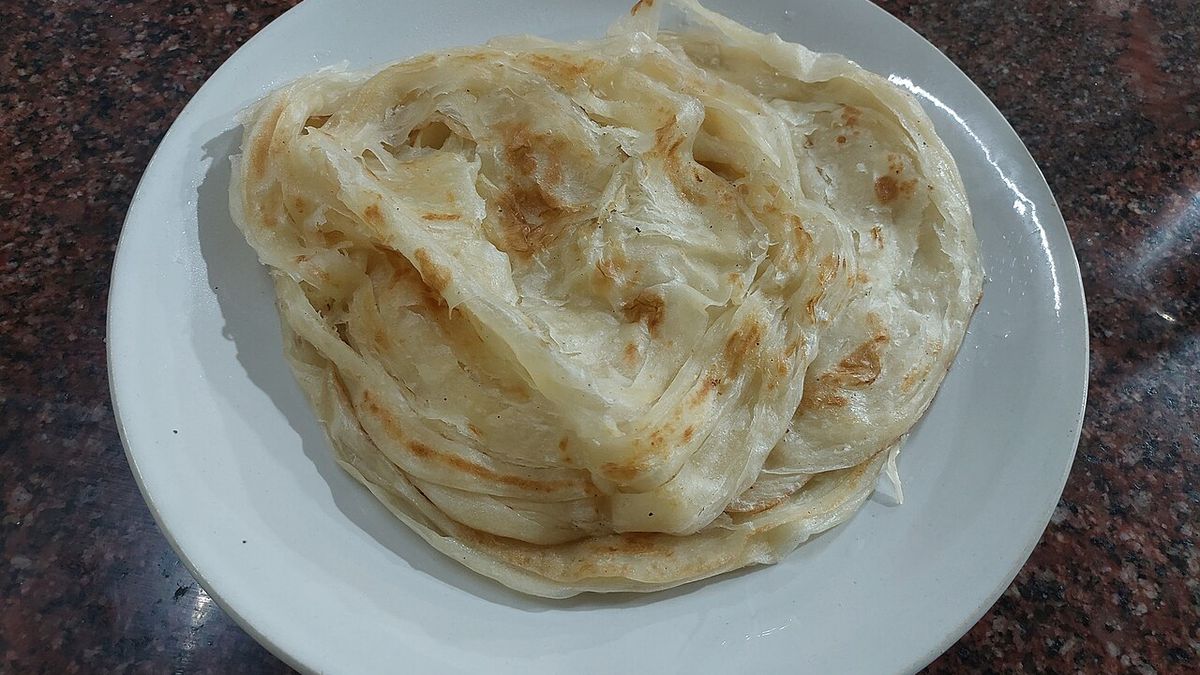
Malabar parotta is a flaky, many-layered flatbread from Kerala, made from a soft maida dough that is oiled, stretched very thin, coiled and griddled. Resting decides whether it succeeds: a dough rested for at least two hours stretches without tearing, and a rushed one springs back and gives a chewy, layerless bread.
- Prep
- 40 min
- Cook
- 25 min
- Total time
- 1 hr 5 min
- Servings
- 4
- Vegetarian
- Vegan
Ingredients
- 3 cups maida (refined wheat flour), about 375 g
- 1 teaspoon salt
- 2 teaspoons sugar
- 2 tablespoons neutral oil or coconut oil, for the dough
- 3/4 cup plus 2 tablespoons lukewarm water, about 210 ml, plus a little more if needed
- 1/3 cup neutral oil, for resting and stretching
- 8 teaspoons neutral oil, for the griddle
NNWA health note
Parotta is white flour and oil, and it is a treat bread rather than a daily one. Maida has lost the bran and germ, so it carries little fibre, and the layers depend on fat. That does not make it something to avoid: it is a pleasure worth having now and then. Keep the meal balanced by eating one or two with a protein-rich curry, a vegetable side such as thoran and a salad, instead of a stack on its own. Anyone managing blood sugar should treat it as an occasional bread and follow their dietitian's advice on portions.
Method
- 01
Mix the maida, salt and sugar in a wide bowl, rub in the 2 tablespoons of oil, then add the water a little at a time and bring it together with your hand. It should feel sticky and slack at first, softer than chapati dough.
- 02
Knead on the counter for 10 to 12 minutes, pushing with the heel of your hand and folding back, until the dough is smooth, stretchy and no longer tacky. A small piece should pull out into a thin sheet before it tears.
- 03
Coat the dough with 1 teaspoon of oil, cover with a damp cloth and rest it at room temperature for at least 1 hour.
- 04
Divide into 8 equal balls, smooth each one, set them on an oiled plate, roll them in oil until well coated, cover and rest for a further hour. They should feel soft and floppy when you press them.
- 05
Oil the counter and your palms. Flatten one ball, then press and pull it outwards from the middle, working round the edge, until it is a large sheet thin enough to see the counter through. Small holes do not matter.
- 06
Brush the sheet with oil, gather it from one side into loose pleats like a paper fan, then stretch that rope gently and coil it round itself into a flat spiral. Tuck the end underneath. Repeat with the other balls and rest the coils, covered, for 20 minutes.
- 07
Press a coil outwards with oiled fingers, or roll it very lightly, into a disc about 15 cm across and 4 to 5 mm thick. Press from the middle and go gently, since heavy rolling welds the layers together.
- 08
Heat a heavy iron tawa over a medium-high flame until a drop of water vanishes in a couple of seconds, then lower the flame to medium. Cook a parotta for about 1 minute until pale bubbles rise, flip, add 1 teaspoon of oil round it and cook for 2 to 3 minutes more, turning often, until golden and spotted brown on both sides.
- 09
Lift the hot parotta onto a board. Holding a clean kitchen towel in each hand, or stacking two or three together, clap them inwards from the sides several times until the layers separate and the edges look frayed. Keep them covered in a cloth-lined box until you eat.
Last reviewed on 2 November 2026.
NNWA publishes the name and qualifications of everyone who writes and checks its material. You can see the full teaching team on the faculty page.
Where does parotta come from, and how is it eaten?
Parotta is the everyday bread of Kerala's tea shops and roadside night stalls, and it is just as common across Tamil Nadu, where it is often called a Madurai or Virudhunagar parotta depending on the style. Do not confuse it with the North Indian paratha, which is made of whole wheat and has a different structure altogether. A parotta is torn by hand, its layers soaking up a thin, peppery gravy. In Kerala it is often shredded into the curry and eaten with a spoonful of extra gravy on top.
This recipe gives the eggless home version. Some shops add a little egg or milk to the dough for softness, and if you do this, drop 3 tablespoons of the water for each beaten egg. The stretching and the rest of the method stay the same.
The technique that makes the layers
Three things create the flakes. The first is a soft, well-kneaded dough, since strong gluten is what lets a ball of dough stretch into a sheet. The second is rest, which relaxes that gluten so the sheet stays wide when you pull it. The third is oil between the layers: every pleat traps a film of fat, and that film keeps one layer from sticking to the next as it cooks. Cooks in tea shops swing the dough in the air to thin it, which looks splendid, but pressing and pulling on an oiled counter gives the same thin sheet with far less risk.
The last step is the clap. A griddled parotta looks like a tight disc until it is hit from the sides while still hot. That sharp squeeze breaks the crust and pushes the layers apart. Skip it and you lose half the flakiness you worked for.
What goes wrong, and how do you rescue it?
If the dough tears as soon as you stretch it, the gluten is still tight. Cover it, leave it for another 30 minutes and try again; do not knead more. If the parotta is tough and bready, the dough was too stiff or the disc was rolled too hard. For the next batch, add a tablespoon more water and shape with your fingers. If it comes out pale and dry, the griddle was too cool and it spent too long drying out. If the outside burns while the middle tastes raw, the disc is too thick or the flame too high, so bring it down to medium and turn the bread more often.
A dough that becomes wet and sticky in the fridge can be saved with a light dusting of flour and a minute of kneading, followed by a fresh 30-minute rest.
Substitutions and a whole wheat version
Replacing half the maida with atta gives a nuttier bread with more fibre. It tears more easily and has fewer, thicker layers, so be honest with yourself that this is a cousin of the parotta and not the same thing. Add 2 more tablespoons of water, since atta drinks more. All-atta parottas are possible but closer to a gobi paratha in texture. Coconut oil gives the most Kerala-like aroma, while sunflower or groundnut oil is neutral. Ghee or vanaspati appears in some older recipes; ghee tastes rich, though the bread is then no longer vegan.
What goes with Malabar parotta?
The classic plate is a thin, coconut-based or pepper-laden curry. Kerala egg roast is the favourite at breakfast, Kerala fish curry or a home-style chicken curry suits dinner, and vegetarians can pair it with a vegetable kurma. If the way cooking changes food interests you, NNWA also runs a culinary nutrition course.
Storing and reheating
Parottas are best within an hour of cooking. Stacked in a cloth-lined box they stay soft for about 3 hours. Keep leftovers in an airtight box in the fridge for 2 days and warm them on a dry tawa over a medium flame for about 30 seconds a side, then clap them again to reopen the layers. You can also freeze the shaped, uncooked coils between sheets of baking paper for up to a month, and cook them from thawed.
Learn the science
Culinary Nutrition (Nutrition Chef)
This dish's nutrition reasoning is taught in full in this NNWA course.
What people ask about Malabar Parotta
Can Malabar parotta dough be made a day ahead?
Yes, and many cooks prefer it. Refrigerate the oiled dough in a covered box overnight, then bring it back to room temperature for about an hour before stretching, since cold dough resists and tears at the edges.
Why does my parotta have no layers?
Usually there was too little oil on the stretched sheet, or the coil was rolled with too much pressure. Brush every part of the sheet before pleating, and press the coil out with your fingertips so the spiral stays visible on top.
Do I need a special griddle?
No, though a heavy iron tawa holds heat better than a thin one and browns the bread evenly. A heavy non-stick pan works too, but give it longer to heat up and expect a slightly paler parotta with less crisp edges.
Is parotta the same as Ceylon or kothu parotta?
Kothu parotta is a street dish made by chopping cooked parottas on a griddle with egg, onion and salna. Ceylon parotta is a square, folded version with a stuffing or without one. Both begin with a dough very much like this one.
Can the parotta be frozen after cooking?
It can, for up to a month, with baking paper between the breads. Reheat straight from frozen on a medium tawa until soft and hot, then clap once more. The texture is a little drier than fresh but entirely pleasant.
More recipes
Adai (Mixed Lentil Crepe)
Adai is a thick South Indian crepe made from a coarsely ground batter of rice and several dals, typically chana, toor and urad, with dried c…
Vegetarian · VeganRecipeAppam
Appam is a Kerala pancake made from a fermented batter of raw rice, cooked rice and coconut, cooked in a curved pan so it forms thin lacy ed…
Vegetarian · Gluten-freeRecipeAvial (Kerala Mixed Vegetable Curry in Coconut-Yoghurt Sauce)
Avial is a Kerala main course of mixed vegetables simmered in a coconut and green chilli paste and finished with a spoonful of yoghurt and r…
Vegetarian · Gut-healthRecipe