
North Indian · Main course
Chicken Korma
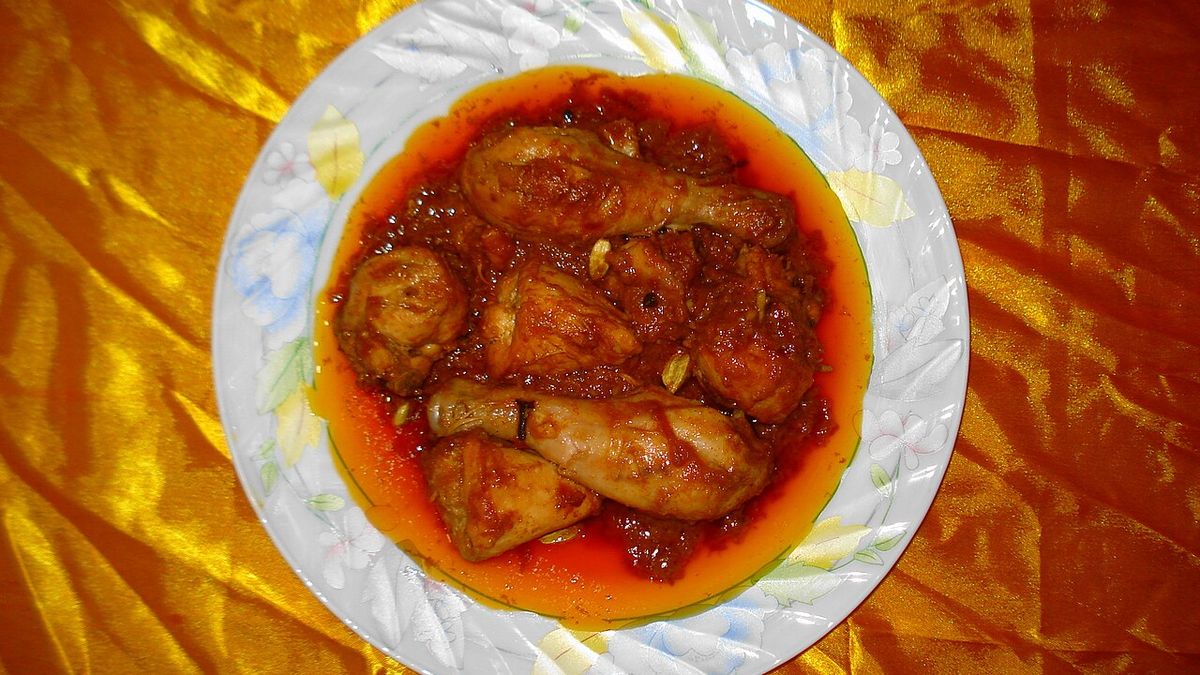
Chicken korma is a Mughlai braise of chicken in yoghurt, browned onions, almonds and whole spices, with a rich but gently spiced gravy. Everything rests on the onions: fried slowly to an even golden brown, they give sweetness and colour. Taken too far, they make the whole pot bitter and nothing can fix it.
- Prep
- 25 min
- Cook
- 1 hr
- Total time
- 1 hr 25 min
- Servings
- 4
- High-protein
- Gluten-free
Ingredients
- 750 g chicken, skinless, bone-in curry cut
- 1 cup thick curd (dahi), about 250 g, at room temperature
- 3 medium onions, about 300 g, sliced thin and even
- 5 tablespoons ghee or neutral oil
- 15 almonds, soaked in hot water for 15 minutes and peeled
- 1 1/2 tablespoons ginger-garlic paste
- 1 bay leaf
- 4 green cardamom pods, lightly crushed
- 4 cloves
- 1 inch cinnamon stick
- 1 small blade of mace (javitri), optional
- 2 teaspoons coriander powder
- 1 teaspoon Kashmiri red chilli powder
- 1/2 teaspoon garam masala
- 1 teaspoon salt, or to taste
- 1 cup hot water
- 1/4 teaspoon kewra water, optional
- A pinch of saffron soaked in 1 tablespoon warm milk, optional
NNWA health note
Chicken korma gives a generous amount of good protein, and the almonds add some unsaturated fat and a little fibre. It is also a rich dish: the ghee and nuts make it heavier than an everyday home chicken curry, so this is one for a special meal, or a smaller portion with plenty of salad. The recipe uses less fat than a typical restaurant korma and no cream, and three tablespoons of ghee will still work if you watch the onions closely.
Method
- 01
Heat the ghee in a heavy, wide pan on medium heat. Add the onions and fry for 15 to 18 minutes, stirring often and constantly towards the end, until evenly golden brown and smelling sweet, not sharp.
- 02
Lift the onions out with a slotted spoon and spread them on a plate; they will darken a shade as they cool and turn crisp. Leave the ghee in the pan and take it off the heat.
- 03
Grind the cooled onions with 3 tablespoons of the curd to a smooth brown paste. Rinse the jar, then grind the almonds with 3 tablespoons of water until creamy, with no grit left between your fingers.
- 04
Return the pan to medium heat and add the bay leaf, cardamom, cloves, cinnamon and mace. Let them sizzle for about 30 seconds, until fragrant and the cardamom pods swell.
- 05
Raise the heat to medium-high and add the chicken in a single layer. Sear for 6 to 8 minutes, turning once or twice, until the pieces look opaque and golden in patches.
- 06
Add the ginger-garlic paste and stir for 2 minutes on medium heat, until the raw smell has gone. Lower the heat, add the coriander powder, chilli powder and salt, and stir for 30 seconds with a splash of water so the spices do not scorch.
- 07
Whisk the remaining curd until smooth. Take the pan off the heat, add the curd 2 tablespoons at a time, stirring well after each addition, then return the pan to low heat for 5 minutes, until the sauce looks glossy.
- 08
Stir in the onion paste, almond paste and hot water. Bring to a bare simmer, cover, and cook on low heat for 25 minutes, stirring every 8 minutes, until the chicken is tender and comes off the bone with a little pressure.
- 09
Cut into the thickest piece to check that there is no pink and the juices run clear. Uncover and simmer on low for 5 minutes, until the gravy coats a spoon and a thin line of fat appears at the edges.
- 10
Off the heat, stir in the garam masala, and the kewra and saffron milk if using. Cover and rest for 10 minutes so the flavours settle, then taste for salt and serve.
Last reviewed on 2 November 2026.
NNWA publishes the name and qualifications of everyone who writes and checks its material. You can see the full teaching team on the faculty page.
A royal braise that became a family meal
Korma, or qorma, comes from a word for braising, and the style belongs to the Mughlai kitchens of North India, particularly Delhi and Lucknow. The meat cooks gently in yoghurt and its own juices, with fried onions and nuts giving body, and with fragrance coming from whole spices in place of heavy chilli heat. Mutton is the older and more traditional meat; chicken is the version most homes cook today, usually for guests or a Sunday meal.
This is the browned-onion North Indian korma. It is a different dish from a South Indian kurma, which usually relies on coconut, as in this Chettinad vegetable kurma, and from the mild, sweet, cream-laden sauce that often goes by the name in restaurants abroad. For a vegetarian relation in the same family, try navratan korma.
Browning the onions properly
Birista, the fried onions used across Mughlai cooking, is what separates a good korma from an ordinary gravy. Slice the onions evenly, because thin slivers burn while thick ones are still pale. Medium heat is the correct setting for most of the time. Early on they steam and go soft, and you can step away for a minute; once they start to turn straw coloured, stay by the pan and keep them moving, because the last two minutes go quickly.
Stop at an even golden brown, the colour of a well-baked biscuit, and take them out with a little colour still to gain, since they keep cooking from their own heat on the plate. If any have gone truly black, throw out the batch. A burnt onion paste cannot be hidden by anything, and starting again costs you three onions and saves a whole pot of chicken.
Keeping the yoghurt from splitting
Curd splits when it hits a very hot pan, leaving small white flecks in a thin sauce. Three simple habits prevent it. Bring the curd to room temperature, whisk it smooth, and add it in spoonfuls off the heat. Keep the pot at a gentle bubble and never a hard boil from then on. Full-fat curd is much more stable than low-fat, and the almond paste helps to hold the sauce together.
If it does split, the taste is fine and only the look suffers. Take the chicken out, blend the sauce with a stick blender or in a mixer jar with one more spoonful of almond paste, and return it all to low heat. No guest will notice.
Other things that can go wrong
A thin gravy just needs more time with the lid off. A gravy that tastes sour usually means curd that was already old; a little more onion paste or a pinch of sugar rounds it out. If the sauce catches on the base of the pan, pour the contents into a clean pot without scraping, and keep the heat lower. Kewra is strong, so measure it, and leave it out altogether rather than guess.
Substitutions and a lighter version
Cashews can replace almonds, giving a slightly sweeter and paler sauce, and in a nut allergy a spoon of roasted, ground melon seeds (magaz) gives similar body if those are safe for you. Boneless thigh works if bone-in is not to hand; reduce the covered cooking to 15 minutes. Mutton is excellent but needs far longer, about 90 minutes on low heat or 20 minutes in a pressure cooker before you finish the gravy uncovered.
For a lighter pot, use three tablespoons of fat, drain the onions well on a rack, and keep the almonds at ten. Use whole-milk curd in any case, because low-fat curd is the one saving that tends to ruin the sauce. More about how much protein the bird itself supplies is on this guide to chicken, and sourced serving figures are on the chicken korma dish page.
Serving, storing and reheating
Korma is at its best with naan or tandoori roti to scoop the gravy, or a plain jeera rice that leaves the spice alone. Sliced raw onion with lemon and a cucumber salad cut the richness. A sharp vegetable side does more for this meal than another heavy curry.
The flavour improves overnight. Cool the korma and refrigerate it within two hours, and eat it within three days, or freeze it for up to a month. Reheat gently on low heat with a splash of water, stirring until steaming hot all the way through, since a hard boil at this stage is what splits the yoghurt.
Learn the science
Sports Nutrition
This dish's nutrition reasoning is taught in full in this NNWA course.
What people ask about Chicken Korma
Can I make chicken korma in a pressure cooker?
You can. Follow the recipe up to the point where the pastes and water go in, then pressure cook for one whistle on medium heat and let the pressure drop naturally. Finish it uncovered until the gravy thickens. The chicken may be softer than in the pan method.
Should korma be spicy?
A traditional korma is fragrant and warm, not fiery. Kashmiri chilli gives it colour with mild heat, so if your family likes more bite, add a slit green chilli with the water. Avoid increasing the garam masala, which turns bitter and heavy in large amounts.
Why is my korma pale when the restaurant one is dark?
The depth of colour comes from the onion paste and the sear on the chicken. Paler onions make a paler gravy with less flavour. Some restaurants use a mixed gravy base and food colour as well, which a home cook does not need.
Can I make the fried onions ahead?
Yes, and many Mughlai cooks do. Fried onions keep for about two weeks in an airtight jar in the fridge if they are fully crisp and dry. Shop-bought birista is a useful shortcut, though check it is fresh, as old packets taste stale and slightly rancid.
Does korma need cream?
No. The body comes from yoghurt, onions and almonds, and a traditional home korma does not include cream. Restaurants often add it for a smoother finish. If you want the effect for a special meal, a tablespoon stirred in off the heat is plenty.
More recipes
Aam Panna
Aam panna is a summer cooler made from cooked raw mango pulp, jaggery, roasted cumin and black salt, diluted with cold water when you want a…
Vegetarian · VeganRecipeAloo Gobi (Potato & Cauliflower Dry Curry)
Aloo gobi is a North Indian dry curry of potatoes and cauliflower cooked together with turmeric, cumin and a light blend of spices until ten…
Vegetarian · VeganRecipeAloo Matar
Aloo matar is a simple North Indian curry of potatoes and green peas in an onion and tomato base. It is one of the most commonly cooked home…
Vegetarian · VeganRecipe