
North Indian · Dessert
Moong Dal Halwa
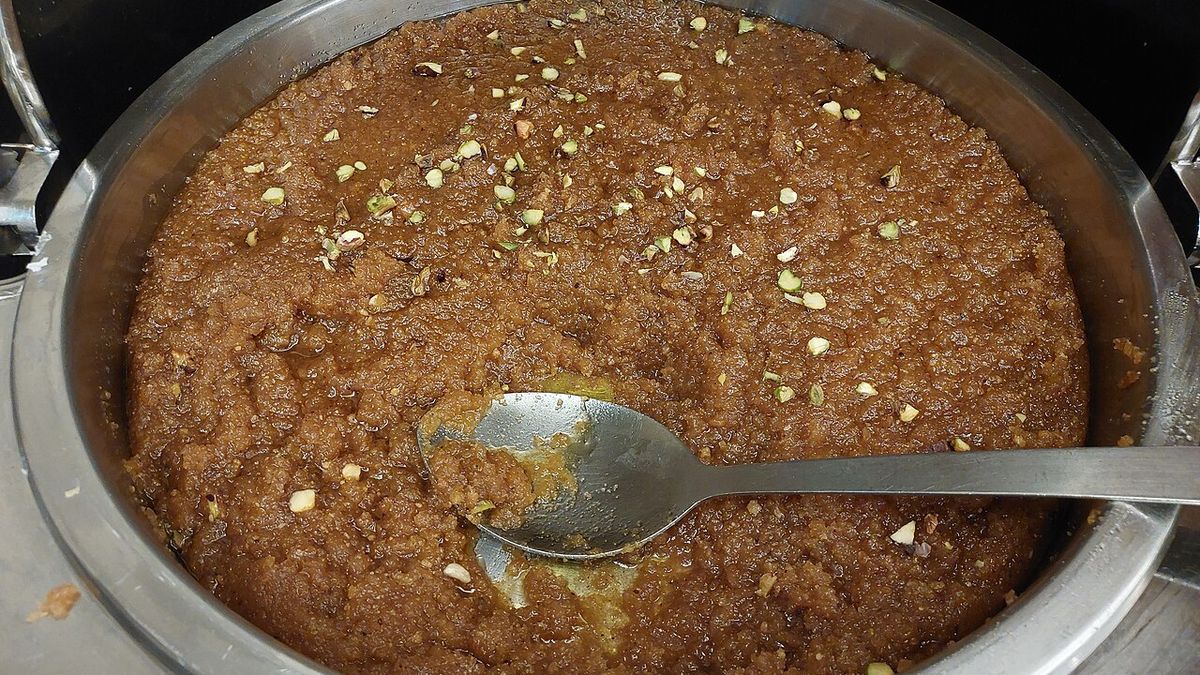
Moong dal halwa is a rich North Indian and Rajasthani sweet of soaked yellow moong, ground coarse and roasted slowly in ghee before milk and sugar go in. Patience with the roast decides it: about half an hour of steady stirring turns a sticky paste into loose, golden, nutty grains. Stopping early leaves it raw-tasting.
- Prep
- 20 min
- Cook
- 55 min
- Total time
- 1 hr 15 min
- Servings
- 8
- Vegetarian
- Festive
- Gluten-free
Ingredients
- 1 cup split yellow moong dal (dhuli moong), about 200 g
- 3/4 cup ghee, about 150 g
- 1 cup full-cream milk
- 1 cup water
- 1 cup sugar, about 200 g, or a little less to taste
- A pinch of saffron
- 1/2 teaspoon green cardamom powder
- 10 almonds, slivered
- 10 cashews, chopped
- 8 pistachios, slivered
NNWA health note
Moong dal halwa is a true festive sweet, full of ghee and sugar, and nobody should pretend otherwise. Moong brings some protein, but with this much fat and sugar the sensible way to enjoy it is in a small portion of a couple of tablespoons, on a day that deserves it. The recipe already uses less ghee than many traditional versions; reducing it much further makes the roasting difficult. If you live with diabetes or a heart condition, your doctor or dietitian's advice on sweets applies here.
Method
- 01
Wash the dal in several changes of water until it runs nearly clear, then soak it for 4 hours. Drain thoroughly in a sieve for 10 minutes so that the grains are not dripping.
- 02
Grind the dal in short pulses with no more than 2 tablespoons of water, scraping down the jar, until it looks like coarse wet sand. A smooth batter is a mistake here, because it gives a pasty halwa.
- 03
Combine the milk, water and saffron in a saucepan and keep it just below a simmer on the lowest heat. The liquid must be hot when it goes in.
- 04
Melt the ghee in a wide, heavy kadai on medium-low heat and add the ground dal. Stir and scrape continually for the first 10 minutes as it turns into a heavy, sticky, pale mass that clings to the ladle, and break up the lumps with the edge of the spatula.
- 05
Keep roasting on medium-low heat for another 20 to 25 minutes, stirring without long pauses, until the mass loosens into separate grains like moist breadcrumbs, the ghee starts to seep out at the edges, the colour is a deep golden, and the kitchen smells of toasted nuts.
- 06
Lower the heat, stand back, and pour in the hot milk and water in a thin stream, as it will spit and steam hard. Stir for 5 to 8 minutes on medium-low heat, until the grains have drunk in all the liquid and swollen.
- 07
Add the sugar and stir on medium-low heat for 6 to 8 minutes. It will turn wet and loose at first, then thicken again, until the halwa comes away from the sides of the pan and ghee glistens on the surface.
- 08
Stir in the cardamom and most of the nuts, and cook for 1 more minute. Turn off the heat, cover for 5 minutes, and serve hot with the remaining nuts on top.
Last reviewed on 2 November 2026.
NNWA publishes the name and qualifications of everyone who writes and checks its material. You can see the full teaching team on the faculty page.
A sweet that takes its time
Moong dal halwa is closely associated with Rajasthan, and it is popular across North India, especially at winter weddings, where it often comes piping hot from a huge kadai. Because it asks for steady stirring and a lot of ghee, it has the status of a sweet you make because someone is worth the effort. The grainy, almost sandy texture and the deep flavour of roasted dal are what set it apart from the softer gajar ka halwa and quick suji halwa.
This recipe follows the traditional method of soaking and grinding the dal, then roasting in ghee. Shortcuts exist and are named below. Some Rajasthani and wedding versions include khoya or more ghee, and you will find quantities that are a good deal richer than these.
The long roast is the recipe
Think of it as three distinct stages. For the first ten minutes or so, you have a glue, heavy, pale and resistant, and you will doubt the recipe. In the middle, it begins to crumble and lighten in colour and in weight on the ladle. In the final stage, the grains separate, ghee appears at the edges, the colour turns deep gold, and the smell turns from raw lentil to something like roasted cashews. Only then is it ready for milk. A medium-low flame is right: too high and the outside browns while the inside stays raw, and too low and you will be there for an hour.
Use a wide, heavy pan and a sturdy flat spatula, since a thin kadai will scorch the base and a round ladle misses the corners. This is good work for two people taking turns; your arm will feel it. The grind matters almost as much as the roast, since a smooth batter never turns grainy and clumps into a dense, cakey sweet.
Mistakes and how to rescue them
If lumps form in the early stage, press them against the sides with the back of the spatula while they are still soft; they break apart as the mass heats through. If it refuses to loosen after 20 minutes, the flame may be low, or the fat is too little. Add another tablespoon of ghee and raise the heat a touch.
A halwa that sets hard once cool has been cooked for too long after the sugar, or it had too little liquid. Warm it through on low heat with a splash of hot milk. A raw lentil taste means the roast was cut short, and sadly there is no complete remedy; extra cardamom and a longer cook with a little more ghee help, but the honest answer is to give it more time on the next attempt. If it has browned too far, stop at once, and add the liquid; it will taste deep and caramelised, and only actual burning is a loss.
Shortcuts, substitutions and how far to lighten it
A common shortcut is to dry-roast the raw dal for 8 to 10 minutes, then coarsely grind it to a powder, or pressure cook and mash it, before cooking it with ghee. It cuts the work, and you lose some of the grain and depth, so it is best called a good everyday halwa and not the wedding article. Some cooks add a tablespoon or two of fine suji or besan during the roast to stop sticking; suji adds gluten, so leave it out if that matters.
You can replace part of the sugar with jaggery, which gives a darker colour, a caramel taste, and no real health advantage. Add it off the heat so the milk does not split. Half a cup of ghee is about the lowest that works; below that the roasting becomes a battle with the pan. Smaller servings are a better way to lighten it than a thin, joyless halwa, and this list of healthier Diwali sweets has better everyday ideas. Sourced figures for a serving are on the moong dal halwa dish page.
Serving, storing and reheating
Serve it hot, in small bowls or as a warm spoonful with a cup of masala chai on a cold evening. At a wedding, you will often see it paired with vanilla ice cream; it is delicious and shameless, and fine for a special day.
Because of the ghee and the long cook, it keeps better than most milk sweets: about a week in a sealed box in the fridge, and up to two months frozen. It sets hard when cold. Warm a portion in a pan on low heat with a teaspoon of milk or in the microwave for 30 seconds, stirring once, until it is soft and glistening again.
Cooks who want to understand why a dish behaves as it does in the pan, and how to adapt a rich recipe, may enjoy the culinary nutrition course. For today, all you need is a heavy pan and a little patience.
Learn the science
Culinary Nutrition (Nutrition Chef)
This dish's nutrition reasoning is taught in full in this NNWA course.
What people ask about Moong Dal Halwa
Is soaking moong dal necessary for halwa?
For the traditional texture, yes. Soaked dal grinds into wet grains that roast evenly and stay separate. If you skip it, the dry-roast and grind shortcut is the alternative. Dal that was soaked for less than two hours grinds unevenly and leaves hard, gritty bits.
How much ghee does moong dal halwa really need?
Traditional recipes use about the same volume of ghee as dal. This one uses three quarters of a cup for one cup of dal, which is enough for proper roasting. Ghee is what stops the grains from sticking, and it comes back out at the end.
Can moong dal halwa be made in advance for a wedding or party?
Yes, and it is one of the best sweets for this purpose. Make it up to five days ahead, keep it in the fridge and warm it in a wide pan with a splash of milk. Add fresh nuts right before serving so they keep their bite.
Why does my halwa look oily?
Some ghee should glisten on the surface, as it is the sign that the halwa is done. Pools of it mean a smaller amount of dal or a slightly excessive pour. Tilt the pan, spoon off the excess and keep it to use for roasting spices later.
Can I use whole green moong or another dal?
Use split yellow moong only for this sweet. Whole green moong has a skin that gives a bitter, dull result, and other dals, such as chana, make a very different sweet that tastes heavier. Skinless moong gives the mild flavour and fine grains that the dish calls for.
More recipes
Aam Panna
Aam panna is a summer cooler made from cooked raw mango pulp, jaggery, roasted cumin and black salt, diluted with cold water when you want a…
Vegetarian · VeganRecipeAloo Gobi (Potato & Cauliflower Dry Curry)
Aloo gobi is a North Indian dry curry of potatoes and cauliflower cooked together with turmeric, cumin and a light blend of spices until ten…
Vegetarian · VeganRecipeAloo Matar
Aloo matar is a simple North Indian curry of potatoes and green peas in an onion and tomato base. It is one of the most commonly cooked home…
Vegetarian · VeganRecipe